

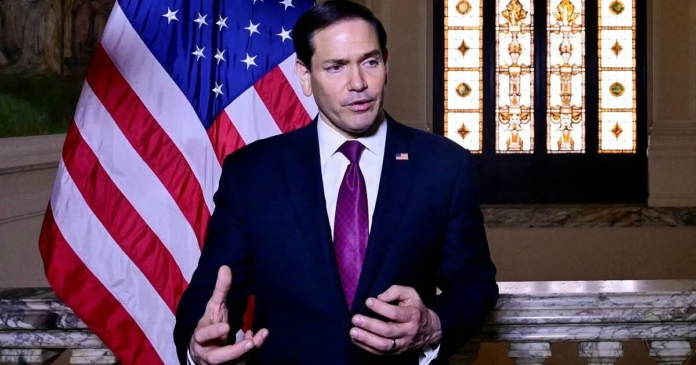
The fragile ceasefire between the United States and Iran continued to face serious pressure on Saturday, May 9, as President Donald Trump confirmed the truce is still technically in effect while the United States awaited a formal response from Tehran on a new peace proposal. American forces fired on two Iranian-flagged oil tankers earlier in the week attempting to bypass the ongoing naval blockade, and Secretary of State Marco Rubio acknowledged in Rome that Iran’s internal political dysfunction may be slowing its response. The coming hours are likely to determine whether the war enters a new negotiating phase or slides back toward open conflict.
Story Highlights
- Trump said the U.S. expects a response from Iran “supposedly tonight” on a proposal to end the war, with Rubio describing Iran’s government as “highly fractured”
- U.S. military forces fired on two Iranian-flagged oil tankers attempting to bypass the naval blockade of Iranian ports
- Iran’s Foreign Minister condemned the strikes, saying Tehran would “never bow to pressure”
What Happened
President Donald Trump confirmed on Saturday that the ceasefire between the United States and Iran remains in effect, even as the United States military reported additional strikes against Iranian-flagged vessels earlier in the week. Speaking to reporters, Trump indicated Washington was expecting a formal response from Tehran on a peace proposal, saying it would come “supposedly tonight.” The administration has framed its proposal as a pathway to ending the conflict that began in February 2026 following a dramatic escalation involving the Strait of Hormuz.
Secretary of State Marco Rubio, speaking from Rome, told reporters that the United States had not yet received Iran’s response. He described Iran’s governing structure as “highly fractured” and “dysfunctional,” suggesting those internal dynamics may be impeding Tehran’s ability to deliver a unified answer. Rubio said the hope was for something that could launch “a serious process of negotiation.”
The situation escalated earlier in the week when U.S. Central Command reported that American warships transiting the Strait of Hormuz had come under missile and drone fire from Iranian forces. The United States responded with strikes on Iranian military facilities, targeting three ports along the Strait: Bandar Abbas, Qeshm, and Bandar Kargan. Trump characterized the American strikes as relatively restrained, while warning Iran that far heavier action remained an option.
Iran’s Foreign Minister Abbas Araghchi responded sharply, posting on social media that Tehran would “never bow to pressure” and accusing Washington of choosing military action over diplomacy at critical moments. The statement reflected the deeply adversarial dynamic still defining negotiations even as both sides nominally maintain the ceasefire framework that Pakistan helped broker in April.
The UAE reported on Friday that its air defense systems engaged a ballistic missile and multiple drones launched from Iran, resulting in three injuries. The UAE’s Ministry of Defense noted that since the conflict began, its systems have intercepted hundreds of ballistic missiles and thousands of drones, with a total of 230 injuries reported.
Why It Matters
The U.S.-Iran conflict is the most consequential military engagement the United States has undertaken in the Middle East since the Iraq War era, and its resolution — or escalation — will define a significant portion of Trump’s second term. The president has invested considerable personal credibility in securing a deal, and the administration’s messaging has consistently described the ceasefire as a step toward a comprehensive agreement rather than an indefinite status quo.
For the American public, the stakes are both military and economic. U.S. service members have been operating in a war zone where Iranian forces continue to take hostile action, and the blockade of Iranian ports has had cascading effects on global oil prices. The administration is managing active combat operations while simultaneously attempting to negotiate, a balancing act with few historical parallels.
The question of Iran’s nuclear program sits at the center of every negotiation. Trump has stated publicly that any agreement must include a complete end to Iranian uranium enrichment, and that the United States would work with Iran to remove existing nuclear material. Iran has rejected those terms publicly even while engaging in talks, and the gap between the two positions remains significant.
Rubio’s description of Iran’s government as fractured also carries important implications. A negotiating partner that cannot speak with a single voice may be unable to deliver on whatever terms are eventually agreed to — a lesson the United States learned in previous rounds of nuclear diplomacy with Tehran.
Economic and Global Context
The closure of the Strait of Hormuz has been among the most economically disruptive consequences of the conflict. The strait handles roughly one-fifth of global oil trade, and its effective closure has pushed U.S. gasoline prices to approximately $4.46 per gallon — the highest level in nearly four years. Some analysts have warned that prices could reach $5 per gallon if the strait remains closed for an extended period.
Global food security has also been affected. The United Nations Food and Agriculture Organization reported that uncertainty around the strait is driving up energy and fertilizer costs, which affects agricultural production worldwide. While cereal supplies are forecast to hold through 2026, next year’s wheat output remains uncertain in the current environment.
Shipping insurance costs have surged since the conflict began. The world’s commercial shipping fleet has been navigating a complex threat environment in and around the Strait of Hormuz, and industry groups have warned that even after a political agreement is reached, it may take additional time before those waters are considered reliably safe for commercial traffic.
Implications
If Iran delivers a serious counter-proposal and negotiations advance, it could mark the beginning of a de-escalation that relieves pressure on global energy and shipping markets relatively quickly. Trump would gain a major diplomatic achievement at a moment when his approval rating is under pressure from domestic economic concerns.
If Iran’s response is dismissed or negotiations break down again, the United States faces a difficult choice between resuming large-scale strikes — which carry risks of broader regional destabilization — and accepting a prolonged standoff. Neither option is without significant cost.
For U.S. allies in the region, particularly the UAE, continued Iranian attacks are already testing civilian infrastructure and public confidence. Gulf nations are watching the outcome of Washington’s negotiations closely to determine whether American deterrence holds as a long-term guarantee.
Congress is also a factor. At least one lawmaker has introduced legislation seeking a 90-day deadline on military action, reflecting broader anxiety on Capitol Hill about the administration’s legal authority to sustain combat operations without a formal authorization.
Sources
“Day 70 of Middle East conflict — US hopes for ‘serious offer’ from Iran”
