

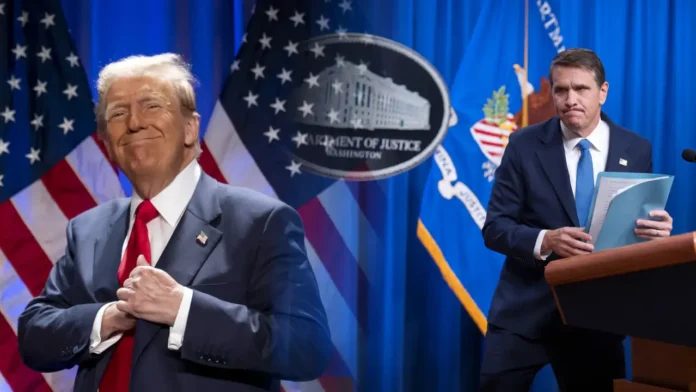
Story Highlights
- A federal judge in Virginia temporarily halted all operations of the anti-weaponization fund, barring the DOJ from transferring money or processing claims
- Acting AG Blanche told Congress the DOJ is “not moving forward with the fund, period,” formally scrapping it
- The fund was created as part of a settlement of Trump’s own $10 billion lawsuit against the IRS, raising fraud-on-the-court questions
What Happened
U.S. District Judge Leonie Brinkema barred the Justice Department from taking any further action to create the so-called anti-weaponization fund, including transferring money to the fund, considering any claims, or making any payments out of it. The temporary pause was necessary, the judge said, to give the court time for a full briefing from both sides of the legal arguments before any funds were irreversibly paid out. NPR
The fund was created as part of a settlement agreement between the DOJ and President Donald Trump, who in return dropped his $10 billion lawsuit against the Internal Revenue Service over his leaked tax returns. It would have allowed individuals who claim they were victims of government “weaponization” to apply for compensation or formal apologies through a commission reviewing claims through 2028. Newsweek
Acting Attorney General Todd Blanche told members of Congress that the Trump administration’s controversial $1.776 billion anti-weaponization fund had been scrapped. “We are not moving forward with the fund, period,” he told the House Appropriations Subcommittee for Commerce, Justice, Science, and Related Agencies. Notably, Blanche said the DOJ will uphold the rest of the settlement — which includes provisions that shielded Trump, his family and his companies from any tax audits or enforcement. NPR
U.S. District Judge Kathleen Williams directed Trump, his adult sons, and the Trump Organization to respond by June 12 to accusations raised by nearly three dozen former federal judges that they acted in a collusive manner with Justice Department lawyers representing the IRS to reach an out-of-court settlement. CNN
Senate Republican Leader John Thune said the fund was a “settled issue,” citing Blanche’s congressional testimony that the DOJ would not move forward with it, though Democratic and some Republican senators argued that only a statutory ban could permanently resolve the controversy. CNBC
Why It Matters
The anti-weaponization fund was one of the most legally and politically audacious moves of the second Trump term — a mechanism that would have directed nearly two billion dollars in taxpayer money to compensate individuals who claim the federal government persecuted them. Depending on how claims were adjudicated, that could have included January 6 defendants, Trump allies prosecuted in the first term, and any number of conservative figures who have argued that federal law enforcement targeted them for political reasons.
The legal theory underlying the fund was contested from the start. Critics — including nearly three dozen former federal judges — argued that the settlement agreement through which the fund was created was itself a fraud on the court, because Trump was effectively on both sides of the transaction: as plaintiff suing the IRS and as president directing the DOJ’s settlement strategy. That conflict of interest lies at the heart of the ongoing judicial inquiry.
For the Republican senators who spent weeks in difficult procedural fights over whether to ban the fund through the immigration enforcement bill, the episode was a costly distraction. The fund consumed legislative oxygen that could have been used on other priorities, damaged the administration’s credibility with moderate Republicans, and produced a Senate vote-a-rama in which GOP members had to repeatedly defend a policy that a majority of them privately opposed.
The fund’s collapse is also a significant victory for the principle that executive branch agencies cannot unilaterally use taxpayer money to settle presidential political grievances. Whether that principle holds depends on whether the courts formalize their preliminary ruling in the coming weeks and whether Congress eventually codifies the prohibition.
Economic and Global Context
The legal and economic implications of a functioning anti-weaponization fund would have been substantial. Estimating the volume of claims that would have been filed is difficult, but the $1.776 billion cap represented a significant upper bound on taxpayer exposure. Had the fund proceeded, it would have set a precedent for future administrations — of either party — to use DOJ settlement authority for purposes that critics describe as political patronage rather than legitimate legal redress.
The IRS tax audit shield provision, which Blanche confirmed will remain in force as part of the settlement even after the fund is scrapped, has its own significant financial implications. Under the settlement, Trump, his family members, and the Trump Organization are protected from IRS investigation for past tax matters. That provision has received less public attention than the fund but carries potentially greater long-term financial value to the Trump family’s private interests.
The legal proceedings that follow — including the court’s fraud-on-court inquiry and any challenge to the IRS audit shield — will have implications for future presidents’ ability to use the DOJ as a vehicle for settling personal financial disputes with the government. If courts rule that the original settlement was improper, the ramifications for executive authority and DOJ independence would extend well beyond this administration.
Implications
The immediate procedural question is the June 12 deadline, by which Trump, his sons, and the Trump Organization must respond to the fraud-on-the-court accusations raised by former federal judges. That response will determine whether Judge Williams formally reopens the underlying IRS lawsuit, which could expose the settlement — including the audit shield — to judicial scrutiny.
Blanche’s nomination as permanent attorney general, announced this week, adds another layer of complexity. Senators who must vote to confirm him will inevitably be asked about his role in creating and defending the anti-weaponization fund, the strategic retreat he executed, and whether the DOJ can be trusted to maintain the audit shield without political interference.
For ordinary Americans watching the spectacle, the episode offers a window into how second-term executive power is being tested. The administration moved aggressively, encountered resistance from the judiciary, from its own party in Congress, and from public opinion, and retreated — keeping what it could and conceding what it could not hold. Whether that pattern continues or whether the administration becomes more restrained in its use of legal and financial instruments is the defining question of the months ahead.
Sources
“Judge temporarily blocks Trump’s $1.8 billion ‘anti-weaponization’ fund”
