

Story Highlights
- The order reclassifies approximately 8,000 senior federal employees, mostly at the GS-15 level, into at-will positions
- Affected workers can now be dismissed without formal disciplinary procedures or appeal rights
- The White House described the measure as “fixing a broken system,” while critics warn it could politicize the civil service
What Happened
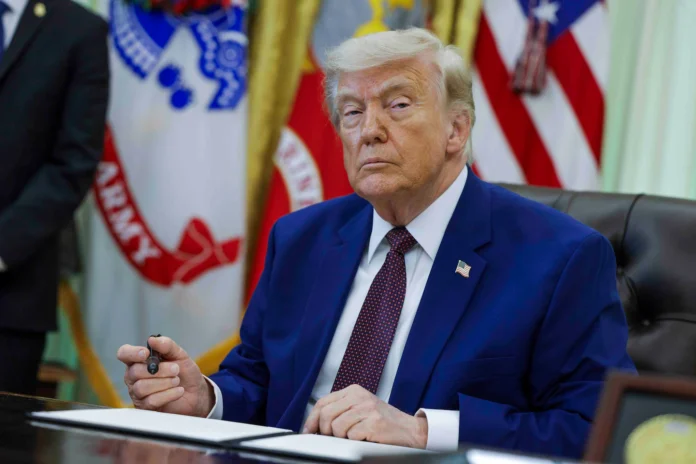
President Donald Trump signed the executive order at the White House on Wednesday, establishing the Schedule Policy/Career classification for federal employees whose roles involve a “confidential, policy-determining, policy-making, or policy-advocating” nature. The action transforms how these workers can be managed by their agencies, removing the formal procedural requirements that previously made it difficult to terminate career employees.
Nearly all of the approximately 8,000 workers affected hold GS-15 positions, the highest level of the federal civil service pay scale. According to the Office of Personnel Management, the affected roles include leaders of policy offices, chiefs of staff, heads of regional offices, program managers, senior public affairs officers, and those who oversee spending and grants. These are not political appointees but career officials who typically serve across administrations.
Under previous rules, federal employees generally had access to formal disciplinary procedures and could appeal termination decisions through established channels, including to the Merit Systems Protection Board. Under the new classification, those protections are removed. The federal government currently has about 4,000 political appointees who already serve at the pleasure of the president; the order effectively adds a new layer of executive control over a much larger group of experienced professionals.
OPM Director Scott Kupor said the order provides agencies with a mechanism to remove employees who undermine the president’s directives, adding that no loyalty tests would be used and that whistleblower protections under federal law remain intact. He emphasized that employees cannot be fired based on political affiliation, though enforcement of that protection would now rest entirely with the agencies themselves, with no independent appeal mechanism for the workers involved.
Why It Matters
The civil service system in the United States was designed to insulate government expertise from political disruption. The principle that career employees serve the government rather than any particular administration has been foundational to how complex federal agencies function, from the Environmental Protection Agency to the Centers for Disease Control and Prevention to the Department of Defense. Stripping protections from 8,000 of the most senior and experienced of those employees represents a meaningful shift in how the federal government will operate.
Proponents of the change, including many conservatives who have long argued for greater executive accountability over the bureaucracy, contend that unelected officials wield excessive power and can frustrate the will of an elected president. They argue that the order restores the constitutional relationship between the executive and the agencies it oversees, ensuring that those implementing policy are actually aligned with those who set it.
Critics counter that the order creates a system where subject matter expertise is less valued than political reliability. Senior policy officials who have spent careers developing technical knowledge in areas such as financial regulation, public health, or national security can now be dismissed not for incompetence but for professional disagreements with political appointees above them. That, critics argue, will degrade the quality of government decision-making over time.
The broader implication is that the executive branch under this framework becomes more responsive to the president in the short term but potentially less capable in the long term. The expertise that career civil servants carry is not easily or quickly replaced, and the prospect of political dismissal may discourage qualified professionals from pursuing or remaining in federal service.
Economic and Global Context
The federal workforce touches virtually every sector of the American economy, from financial regulation to agricultural policy to infrastructure management. Senior policy officials at the GS-15 level are often the people who write the rules, manage the contracts, and make the discretionary decisions that affect businesses and individuals across the country. Changes to how those officials are selected, retained, and managed can have downstream effects on regulatory consistency and institutional reliability.
For financial markets, the stability and predictability of federal agencies is a background assumption built into countless investment decisions. Rating agencies and institutional investors watch changes to regulatory structures closely, and sustained disruption to the civil service can factor into assessments of U.S. governance risk.
Internationally, the strength and competence of American government agencies is part of what underpins U.S. credibility on the world stage. Allies in foreign ministries and international organizations often rely on relationships with experienced American counterparts who carry institutional memory. Rapid turnover at senior levels can disrupt those relationships and slow the work of multilateral institutions.
Implications
Legal challenges to the order are anticipated. Skye Perryman, president and CEO of Democracy Forward, one of the organizations that has already challenged prior reclassification efforts, said in a statement that the country has long relied on a professional, nonpartisan civil service. The courts have already been reviewing related OPM reclassification efforts, and the scope of this order will likely be tested under the Administrative Procedure Act and other statutory frameworks.
The administration has not ruled out expanding the pool of affected workers in the future. OPM had originally estimated that as many as 50,000 positions could eventually be reclassified under the Schedule Policy/Career framework, suggesting that Wednesday’s order may be an initial step rather than the full extent of the effort. The number 8,000 is smaller than many expected, possibly reflecting litigation caution.
For federal employees, the immediate practical effect is a significant reduction in job security. The longer-term consequences for federal recruitment and retention could be substantial, particularly as the private sector and state governments compete aggressively for the same pool of technically skilled professionals. How the government manages that competition will shape the quality of public administration for years to come.
Sources
