

Situation Overview
In a major legal development this week, the U.S. Supreme Court ruled that President Donald Trump exceeded his authority when using emergency powers to impose sweeping global tariffs. The decision, issued within the past 72 hours, invalidated the administration’s reliance on the International Emergency Economic Powers Act (IEEPA) for broad tariff enforcement.
However, within hours of the ruling, President Trump announced a revised trade strategy — invoking a separate statutory authority under the Trade Act of 1974 to implement a new 15% global tariff framework. The swift response underscored the administration’s determination to continue prioritizing American industry and domestic manufacturing despite judicial setbacks.
The ruling immediately sparked reactions from global markets, foreign governments, and congressional leaders, placing trade policy once again at the center of Washington’s political debate.
What Happened
The Supreme Court Decision
• In a 6–3 ruling, the Supreme Court determined that the president’s use of emergency powers to impose broad, country-wide tariffs lacked clear congressional authorization.
• The majority opinion emphasized that tariff authority fundamentally rests with Congress unless explicitly delegated.
• The decision effectively struck down the administration’s prior emergency tariff structure.
Trump’s Immediate Pivot
• Following the ruling, President Trump announced he would use Section 122 of the Trade Act of 1974, which allows temporary tariff measures to address trade imbalances.
• The White House confirmed that a 10% tariff would be imposed immediately, with the rate increasing to 15% — the statutory maximum under that provision.
• Administration officials described the move as legally sound and consistent with long-standing executive authority under trade law.
International and Domestic Reaction
• European Union officials cautioned against further tariff escalation and called for renewed negotiations.
• Some Asian trade partners signaled delays in ongoing talks until legal clarity is restored.
• U.S. markets showed short-term volatility as investors assessed the economic impact.
Despite external pressure, the administration framed the transition as a recalibration rather than a retreat.
Trump/GOP Response
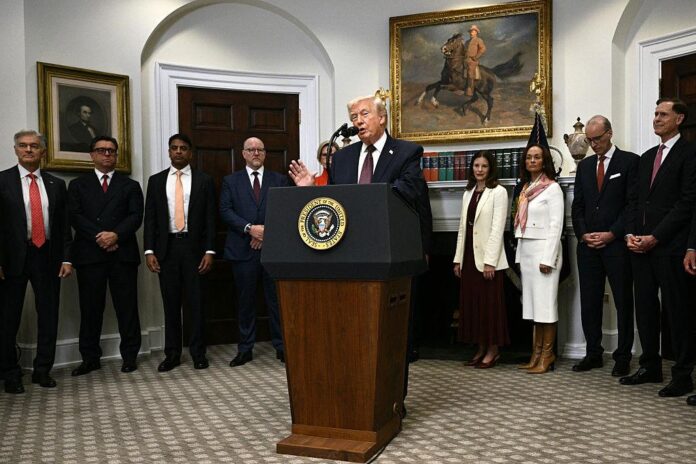
President Trump addressed the ruling directly, stating that while he disagreed with the Court’s interpretation, his commitment to protecting American workers remains unchanged.
The White House emphasized three key points:
-
The new tariff structure complies with existing trade law.
-
The policy continues to target unfair trade practices and long-standing trade deficits.
-
American manufacturing and job protection remain top priorities.
Republican lawmakers broadly supported the president’s pivot strategy. Several GOP leaders stated that Congress should clarify executive trade authority to prevent similar disputes in the future.
Strategically, the administration’s rapid legal shift signaled to both allies and competitors that U.S. trade enforcement will continue without pause. For Trump supporters, it reinforced an image of adaptability and resolve under legal and political pressure.
Who Is Involved
• President Donald Trump — Leading the administration’s trade policy response and implementing revised tariff authority.
• U.S. Supreme Court Justices — Issued the 6–3 ruling limiting emergency tariff powers.
• U.S. Trade Representative Office — Coordinating implementation of the revised tariff framework.
• European Commission Trade Officials — Publicly responding to the tariff increase.
• Congressional Republican Leaders — Signaling legislative interest in clarifying trade authority.
Why It Matters
Economic Impact
Tariffs directly influence import prices, domestic manufacturing competitiveness, and supply chain costs. The revised 15% tariff rate represents a significant policy tool that could reshape trade relationships moving forward.
Constitutional Balance of Power
The case highlights ongoing tension between executive authority and congressional oversight in economic policymaking. It clarifies legal boundaries while leaving room for statutory trade enforcement tools.
Political Implications
Trade policy has long been central to Trump’s political identity. By quickly implementing an alternative approach, the administration avoided the perception of retreat and maintained momentum heading into critical legislative months.
For Republican lawmakers, the moment provides an opportunity to advocate for clearer statutory backing for trade enforcement, reinforcing a platform centered on economic sovereignty.
What’s Next
• Congressional committees are expected to hold hearings examining the scope of presidential trade authority.
• Trade partners may pursue accelerated negotiations to avoid prolonged tariff exposure.
• The administration will likely defend the revised tariffs in lower courts if challenged.
• The issue could become a focal point in upcoming economic policy debates ahead of the midterm election cycle.
As the legal and political process unfolds, the administration appears intent on ensuring that U.S. trade leverage remains intact.
