

Story Highlights
- Trump announced the Blanche nomination at a White House dinner, declaring “we are going to make him permanent attorney general”
- Blanche has served as acting AG since April after Trump fired Pam Bondi, using the tenure to pursue Trump allies’ agenda aggressively
- The nomination faces scrutiny from both Democrats and some Republicans over the $1.776 billion anti-weaponization fund Blanche championed
What Happened
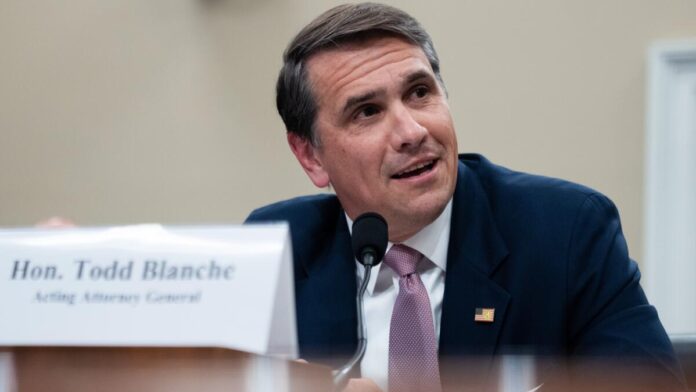
President Donald Trump said he will nominate Todd Blanche to serve as attorney general, tapping his former personal lawyer who has aggressively pursued the Republican president’s agenda while leading the Justice Department in an acting role. Trump said at a dinner at the White House that he plans to nominate Blanche formally, according to a video of the event posted on social media by a White House aide. NPR
Trump is elevating Blanche days after his most public setback. The acting AG spent weeks defending a nearly $1.8 billion “anti-weaponization” fund, a taxpayer payout to people who say they were wrongly targeted by the government. After Senate Republicans balked, especially at the prospect of payouts to January 6 rioters, he killed the fund. Axios
Blanche was brought into the Justice Department as deputy attorney general and was elevated after Bondi’s ousting over her failed efforts to prosecute Trump’s perceived political opponents. Blanche’s actions have outraged Democrats and other critics who accuse him of still acting like Trump’s personal lawyer to carry out the president’s campaign of retribution. NPR
When asked about Blanche at a White House event to promote the coal industry, Trump said “Todd is very popular and doing great.” White House spokeswoman Abigail Jackson said Blanche has “done an excellent job as acting attorney general and will continue doing so as attorney general,” adding that he is “an American patriot who fearlessly fought on behalf of President Trump against the Democrats’ illegal and unprecedented lawfare campaign.” Washington Times
Confirmation would keep the Justice Department in the hands of Trump’s former criminal defense attorney, who has used his tenure to fight judges, indict former FBI director James Comey, and dismiss critics of the department’s handling of the Epstein files. Axios
Why It Matters
The attorney general is the chief law enforcement officer of the United States and oversees an agency of roughly 115,000 employees with authority over federal criminal prosecutions, civil rights enforcement, national security investigations, and the FBI. Who holds that position permanently — not merely in an acting capacity — shapes the legal and institutional character of the entire federal government for years beyond any single administration.
Blanche’s potential confirmation would formalize a vision of the Justice Department as an instrument of presidential loyalty rather than prosecutorial independence. Critics from across the political spectrum have raised alarms about the department’s direction under his brief tenure, pointing specifically to the indictment of Comey, the creation of the anti-weaponization fund, and what many lawyers describe as an unprecedented conflation of the president’s personal legal interests with the federal government’s institutional role.
For Republican senators who must vote on confirmation, the calculus is uncomfortable. Blanche carries significant political baggage from the anti-weaponization fund controversy, which exposed the administration to accusations of using taxpayer money to reward political allies. Several senators who pushed back hardest on that fund will now be asked to confirm the man who championed it. Their votes will be closely watched by both conservative and independent voters heading into the 2026 midterms.
The broader political stakes are considerable. An attorney general who views his mandate as protecting the president and pursuing his opponents is a fundamentally different institution from one that maintains even nominal independence. How the Senate handles this confirmation will signal how much institutional deference Congress is prepared to extend to an administration that has consistently tested the boundaries of executive power.
Economic and Global Context
The Justice Department’s leadership has direct implications for major corporate enforcement actions, antitrust oversight, and financial regulation. Under Blanche’s acting tenure, the department’s enforcement priorities have shifted sharply toward immigration-related prosecution, political-opposition investigations, and executive branch loyalism rather than white-collar crime, corporate misconduct, or consumer protection.
International observers, particularly in allied democracies with independent judicial traditions, have been watching the Trump-era Justice Department with growing concern. The perception that federal prosecutors operate at the direction of the White House — rather than according to law — undermines American credibility in international rule-of-law discussions and creates friction in diplomatic settings where legal standards are central to relationship management.
For American businesses, the attorney general’s posture on antitrust enforcement and regulatory litigation has direct financial consequences. Companies navigating major mergers or regulatory actions under the current administration are adjusting their legal strategies based on an assumption that the DOJ is less focused on structural market oversight and more focused on political priorities.
Implications
The Senate confirmation process for Blanche will serve as a referendum not just on one individual but on the direction of the Justice Department itself. Democrats are expected to mount a forceful opposition, pointing to Blanche’s record on the anti-weaponization fund, his indictment of Comey, and his overall tenure as evidence that he cannot be trusted to execute the law impartially.
The confirmation timeline is unclear. Senate leadership has not announced a schedule, and the immigration enforcement funding bill consumed significant legislative bandwidth this week. If confirmation hearings are scheduled for late June or July, the proceedings will unfold in the shadow of midterm campaign season, intensifying the political pressure on every senator’s vote.
If confirmed, Blanche would likely continue accelerating the policy directions he established as acting AG. If the nomination fails — a real possibility given the anti-weaponization fund backlash — Trump would need to identify a new nominee, likely someone with a similarly aggressive profile but a cleaner political record. Either outcome will define the legal legacy of the second Trump term.
Sources
“President Trump says he will nominate Todd Blanche to serve as attorney general”
