

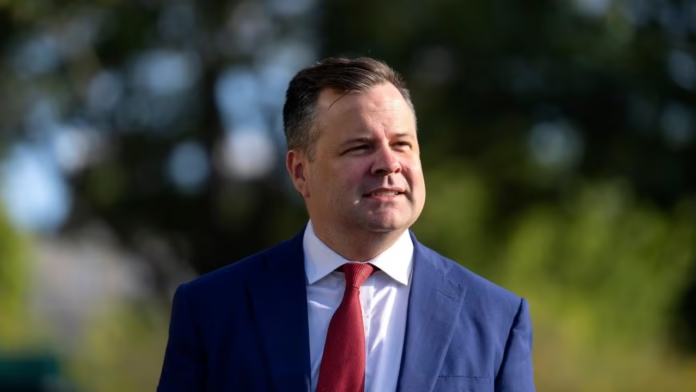
Story Highlights
- Pulte will simultaneously serve as FHFA director and chairman of Fannie Mae and Freddie Mac while leading the intelligence community
- Gabbard announced last month she would resign effective June 30 to care for her husband, who is being treated for bone cancer
- Pulte has previously filed criminal referrals against a Federal Reserve governor and the New York attorney general on Trump’s behalf
What Happened
President Donald Trump said Tuesday he was appointing Bill Pulte as acting director of national intelligence to replace Tulsi Gabbard. Pulte currently serves as director of the Federal Housing Finance Agency, which oversees the U.S. housing finance system, and will retain that role and his chairmanship of Fannie Mae and Freddie Mac.
Multiple sources familiar with the decision told CNN that the rationale for the pick was simple: Trump liked what he saw from Pulte and believed he could potentially replicate it at DNI. Trump made his decision to put Pulte in the role Monday night. Trump previously announced that Principal Deputy Director of National Intelligence Aaron Lukas would become the acting director when Gabbard leaves her office on June 30. The change in plans signals a last-minute decision by the president to install someone he considers a more aggressive operator.
Trump sees the director of national intelligence as playing a central role in election security, both past and present, and has been impressed with Pulte finding novel ways to use his housing role to go after political foes. Sources described Pulte as a “move-fast-and-break-things kind of guy” — precisely the temperament Trump wanted in charge of the intelligence community.
Pulte last year filed a criminal referral against Federal Reserve Governor Lisa Cook for mortgage fraud. Trump attempted to fire Cook based on those allegations; Cook sued to block the firing, and her case is currently pending before the Supreme Court. Pulte also submitted a criminal referral against New York Attorney General Letitia James on allegations of falsifying bank documents, and James was subsequently charged with bank fraud and making false statements.
Because Pulte has previously been confirmed by the Senate for another position, he is eligible to perform in an acting role without further congressional approval. White House spokesman Davis Ingle said in a statement: “The President chooses the best and most talented people to serve in his Cabinet. Bill Pulte is a great selection and he will do a great job on behalf of the American people.”
Why It Matters
The appointment of a figure with no intelligence background to lead the nation’s spy agencies is unprecedented in modern American history. The director of national intelligence oversees 18 federal intelligence agencies, including the CIA, the NSA, and the Defense Intelligence Agency. That position demands coordination of complex, classified operations, threat assessments, and briefings for the president and senior policymakers. Critics argue that placing a loyalist with a track record of political retribution in that role introduces risks that extend far beyond any single administration.
One critic said he fears Pulte “will be willing to shape intelligence around the president’s wishes, regardless of the cost to the American people.” That concern is not abstract. Historically, the danger of politicized intelligence — where assessments are skewed to confirm preferred narratives — has led to disastrous policy outcomes, most notably the faulty intelligence cited ahead of the 2003 invasion of Iraq. Placing a political operative at the helm of the intelligence apparatus heightens those risks considerably.
Pulte’s dual role raises additional concerns about divided attention. Managing Fannie Mae and Freddie Mac alone represents oversight of more than $10 trillion in mortgage-backed securities. Adding leadership of the entire intelligence community to that portfolio is a span of responsibility without recent parallel in Washington. Whether one individual can meaningfully perform both functions simultaneously is a question that career intelligence professionals are already asking.
The timing also matters. The United States is currently engaged in an active military conflict with Iran, making the quality and integrity of intelligence assessments critically important for decisions that affect American lives abroad. Transitioning leadership of the DNI under these circumstances adds an element of institutional uncertainty that allies and adversaries alike will be watching closely.
Economic and Global Context
The Federal Housing Finance Agency, which Pulte will continue to lead, plays a central role in the stability of the American mortgage market. Fannie Mae and Freddie Mac collectively back the majority of home loans issued in the United States. Any distraction or mismanagement at the FHFA during a period of elevated interest rates and housing market stress carries real economic consequences for American homeowners and the broader financial system.
On the intelligence side, the DNI coordinates threat assessments that directly inform decisions about troop deployments, sanctions, and diplomatic initiatives. In the context of the ongoing Iran conflict, those assessments feed into decisions about ceasefire negotiations, targeting, and the posture of U.S. forces across the Middle East. Allies in Europe and Asia monitor the integrity of American intelligence institutions closely, as shared intelligence forms the backbone of joint security arrangements under NATO and bilateral agreements.
Markets have not reacted dramatically to the appointment itself, but the broader uncertainty surrounding American institutional stability in 2026 remains a backdrop factor in investor sentiment. Foreign governments — including partners involved in Iran negotiations — will factor the credibility of American intelligence outputs into their own strategic calculations.
Implications
If Pulte moves aggressively to reshape the intelligence community in line with White House political priorities, the consequences could be lasting. Career intelligence officers may face pressure to produce assessments that align with presidential preferences rather than raw data, eroding institutional norms built over decades. Congress retains oversight authority over the intelligence community, and Democratic lawmakers are already signaling they will use hearings and subpoenas to scrutinize Pulte’s conduct.
Pulte’s track record of pursuing Trump’s political enemies could translate into redirected surveillance and investigative priorities inside the intelligence apparatus. That prospect alarms civil liberties advocates and former intelligence officials alike. Whether the acting designation becomes permanent will depend on whether Trump nominates Pulte for the Senate-confirmed role — a fight that would draw intense scrutiny on Capitol Hill.
For the broader Republican Party heading into the 2026 midterms, the appointment adds another flashpoint to debates about executive overreach. Democrats will use the confirmation battle, if one comes, as an opportunity to highlight concerns about democratic norms. The decision reflects Trump’s governing philosophy clearly: reward loyalty, punish opponents, and install allies wherever institutional levers of power can be found.
