

Story Highlights
- Five of seven Trump-targeted incumbent Republican state senators lost their primaries; one race remained too close to call
- Roughly $13.5 million was spent on advertising in Indiana state senate races, a more than 4,700 percent increase from the prior cycle
- Trump’s push is part of a broader mid-decade redistricting effort aimed at preserving or expanding the Republican House majority ahead of the 2026 midterms
What Happened
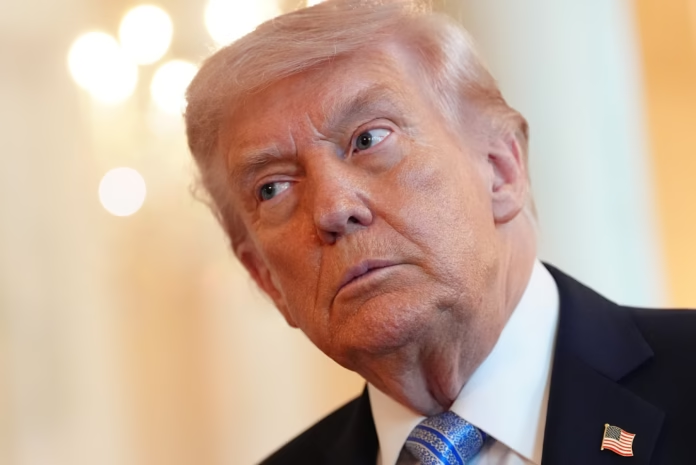
President Donald Trump exacted revenge on Indiana Republican legislators who foiled his redistricting push last year, backing challengers who unseated five incumbents in Tuesday’s primaries. The results delivered a resounding demonstration of Trump’s continued influence over Republican primary voters, even amid declining national approval numbers tied to the Iran conflict and rising gas prices.
Of the 21 Republicans who voted against the new map, eight were up for reelection, and seven faced Trump-backed primary challengers. Most of them will no longer serve in the statehouse. The defeats came despite many of the incumbents holding reliably conservative records on virtually every other political issue. Their sole offense, in Trump’s view, was opposing his congressional map.
The rejection of redistricting in Indiana was watched around the country, as Trump has pushed Republican states to redraw maps to favor their party in the congressional midterms. Several states, including Texas, Missouri, North Carolina, and Ohio, have already undergone mid-decade redistricting at Trump’s urging, making Indiana’s resistance and the subsequent punishment a nationally significant episode.
State Sen. Greg Walker was set to retire last year after 20 years in the chamber, but reversed course amid the redistricting fight, where he notably broke down in tears speaking about his fear for the future of the party if the Legislature caved to Trump’s demands. He lost to state Rep. Michelle Davis, who had launched her campaign before Walker decided to run again.
James Blair, a White House deputy chief of staff and one of the chief architects of Trump’s mid-decade redistricting push, said from the Oval Office Tuesday night that the president was in another room taking pictures with dinner guests and not actively monitoring the results. “He knew how we were gonna do,” Blair told reporters.
The Indiana results send a clear warning to every Republican officeholder in the country: opposing Trump’s political agenda — even on state-level procedural matters — carries a serious electoral price. The scale of the losses, combined with the volume of outside money deployed to achieve them, demonstrates that the White House is willing to invest significant resources to enforce party discipline far beyond Washington.
The double-digit defeats of the five incumbents, some of whom are veterans of the Indiana Legislature, underscore the influence Trump continues to wield over the Republican Party, even as his approval rating among Americans broadly sags amid rising gas prices and the Iran war. In practical terms, this means that Republican state legislators across the country now have a concrete, recent example of what happens when they cross the president.
The redistricting stakes extend directly to Congress. Trump has set off an unprecedented mid-decade redistricting race as he tries to maintain the narrow Republican hold on the House. Indiana’s proposed map would have targeted the two remaining Democratic congressional strongholds, eliminating those seats ahead of the fall midterms. Although that specific effort failed — and the primary results do not resurrect it for 2026 — the newly elected senators may be more amenable to a fresh attempt next year.
For the Republican Party more broadly, the Indiana results expose a tension between short-term loyalty enforcement and long-term electoral health. While Trump’s political operation unseated the dissidents, political analysts have noted that all of those targeted were Republicans who support a conservative agenda — meaning the net policy change is minimal, but the message of dominance is maximized.
Economic and Global Context
Primary spending on TV ads for Indiana state senate races went from just $280,000 in 2024 to $13.5 million this year, an increase of more than 4,700 percent, according to AdImpact. That extraordinary spending reflects how fully national political money has colonized what were once local contests, reshaping the political economy of state legislatures across the country.
The Club for Growth led the direct mail effort for the pro-Trump forces, and Turning Point USA supplied ground troops for door-to-door get-out-the-vote efforts — seeking to carry out one of the last political stances taken by its late co-founder Charlie Kirk, who was killed weeks after urging Indiana Republican lawmakers to redistrict.
The redistricting wars have economic consequences that extend beyond politics. Congressional maps drawn to entrench partisan majorities shape which communities receive infrastructure investment, regulatory attention, and federal grant funding. Districts designed to be politically uncompetitive often receive less constituent accountability from their representatives, which over time can affect local economic development and public services.
The heightened focus on the Indiana races also highlights how central redistricting and gerrymandering have become to Trump’s political strategy ahead of the midterms, with Democratic-led states pushing back — voters in both California and Virginia having approved redistricting maps designed to solidify Democratic gains.
Implications
The most immediate implication is for Republican lawmakers in states where mid-decade redistricting has not yet been attempted. Before Tuesday’s primary, Republican states across the South — emboldened by a Supreme Court ruling further gutting the Voting Rights Act — were already considering redistricting. The Indiana results will likely accelerate those efforts by demonstrating the cost of refusal.
For Democrats, the results are a mixed signal. Trump’s ability to punish dissidents in Republican primaries is clear. But the tension between Trump’s strength in Republican primaries and Democrats’ improving margins in special elections across the country may not fully resolve until the November midterms, when candidates in battleground districts will be forced to choose between their bases and broader electorates.
For the GOP incumbents who survived, the lesson is complex. Sen. Greg Goode, the only Trump-targeted incumbent projected to win, said his campaign had “blocked out all the noise and all of the drama” — and added that he believed Trump had received bad political advice from Washington insiders who did not understand Indiana.
Nationally, the episode reinforces that primary elections remain the most powerful enforcement mechanism in American politics and that as long as Trump commands a committed primary electorate, the threat of a primary challenge functions as a near-total deterrent against Republican dissent.
Sources
“Trump exacts revenge in Indiana over redistricting vote, with five GOP legislators defeated”
