

Story Highlights
- Iran accused the U.S. of striking an oil tanker and civilian port areas on Friday; the U.S. denied escalating beyond the ceasefire threshold
- Trump paused “Project Freedom” — the U.S. operation to reopen the Strait of Hormuz — citing progress in peace talks brokered by Pakistan
- U.S. gas prices have reached $4.46 per gallon, the highest level in nearly four years, with analysts warning of $5 prices if the strait remains closed
What Happened
Iran’s military said United States forces targeted an Iranian oil tanker in coastal waters and a second vessel near the United Arab Emirates’ Fujairah port, while U.S. air strikes hit civilian areas in Bandar Khamir, Sirik, and Qeshm Island in southern Iran. Iranian air defense systems were also activated over western Tehran. The U.S. did not confirm the strikes but maintained that any actions taken remained below the threshold of a ceasefire violation.
U.S. Defense Secretary Pete Hegseth said the ceasefire “certainly holds,” while Joint Chiefs of Staff Chairman General Dan Caine said the incidents remained “all below the threshold of restarting major combat operations.” Trump, for his part, reiterated publicly that he believed Iran wanted a deal and that talks were progressing.
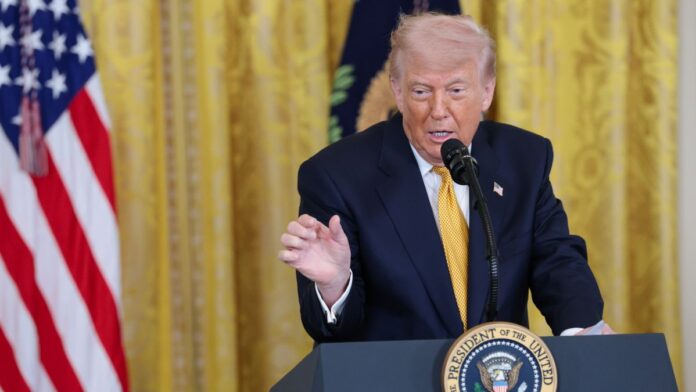
Earlier in the week, Trump told reporters in the Oval Office: “They want to make a deal. We’ve had very good talks over the last 24 hours, and it’s very possible that we’ll make a deal.” Iran’s Foreign Ministry said it was reviewing a U.S. peace proposal and would convey its response, but no formal agreement had been reached as of Friday morning.
The volatile situation on the ground follows Trump’s pause of “Project Freedom,” the U.S. naval operation to escort commercial vessels through the strait. Trump announced the reversal on Truth Social, citing the “request of Pakistan and other countries” and “great progress” toward a “complete and final agreement” with Iran. The pause came just one day after the operation launched, having successfully escorted only two merchant vessels through the contested waterway.
Secretary of State Marco Rubio told a White House press briefing that for peace to be achieved, Iran must agree to Trump’s demands on its nuclear program and also agree to reopen the Strait of Hormuz. Rubio also described the U.S. campaign as a defensive operation aimed at protecting civilian sailors stranded in the strait.
Why It Matters
The contradictions between Trump’s optimistic peace talk and the daily reports of military incidents illustrate the profound fragility of the current situation. A genuine ceasefire that holds on paper but produces ongoing skirmishes in practice creates compounding risks: any single incident could spiral beyond the threshold that even the most cautious military commanders have drawn, dragging the United States back into active hostilities.
Rubio described the stranded sailors in the Strait of Hormuz as “sitting ducks” who are “isolated, starving, and vulnerable,” noting that at least ten sailors had already died as a result of the blockade. That humanitarian dimension of the crisis is often overshadowed by the geopolitical maneuvering but has real and immediate consequences for thousands of civilian maritime workers from dozens of countries.
For American policymakers, the central unresolved question is whether the White House has implicitly accepted Iran’s sequencing demand: settle the strait and end the war first, with Iran’s nuclear program to be addressed separately in follow-on negotiations. Secretary Rubio’s Tuesday briefing suggested a potential departure from earlier U.S. insistence that nuclear concessions be tied directly to any peace framework.
U.S. peace negotiations are being led by Trump envoy Steve Witkoff and son-in-law Jared Kushner, according to Reuters. If both sides agreed on a preliminary deal, that would start the clock on 30 days of detailed negotiations to reach a full agreement. Time pressure is mounting from multiple directions, including the approaching Hajj pilgrimage, which begins around May 25.
Economic and Global Context
Iran’s effective closure of the Strait of Hormuz, through which major oil and gas supplies passed before the war, has sent fuel prices skyrocketing and rattled the global economy. The economic damage is not theoretical — businesses, consumers, and governments worldwide are absorbing sharply higher energy costs with no clear end date in sight.
U.S. gas prices have hit $4.46 a gallon, the highest level in nearly four years. One oil market expert told CNN that prices could reach $5 a gallon if the strait remains closed. That figure would put enormous political and economic pressure on the White House ahead of the November midterm elections, potentially accelerating the push for a diplomatic resolution.
China absorbed more than 80 percent of Iran’s shipped oil in 2025, according to analytics firm Kpler. Beijing’s deep economic ties to Tehran give it unique leverage in the conflict — but also a complex incentive structure. China’s Ministry of Commerce ordered domestic companies to defy U.S. sanctions on five Chinese oil refineries buying Iranian crude oil, invoking for the first time a law allowing Beijing to retaliate against what it considers unlawful foreign sanctions.
The approaching Hajj pilgrimage adds a separate constraint, with roughly 1.8 million Muslims expected to converge on Mecca from around May 25, including Iranian pilgrims. Any escalation during that period would carry severe political costs for all parties. Regional analysts view this convergence of deadlines as making some form of interim agreement more likely in the near term, even if a comprehensive deal remains elusive.
Implications
The most pressing immediate question is whether Iran will formally respond to the U.S. peace proposal — and what concessions, if any, it will demand in exchange. An Iranian Foreign Ministry spokesperson said Tehran would convey its response, though no timeline was specified. The 14-point framework reportedly leaves the key U.S. demands on nuclear suspension and strait reopening unresolved, suggesting the hardest negotiations lie ahead.
For Congress, the War Powers clock is ticking quietly in the background. The Trump administration has cited the April 8 ceasefire in asserting that the president does not have to give a formal update to Congress under the War Powers Resolution, which typically requires presidents to seek formal approval for war activities 60 days after beginning military action. Democrats and some Republicans have pushed back on that legal interpretation.
For global shipping companies and energy markets, the uncertainty is itself a form of economic damage. Even if an agreement is reached, it may take time for political statements and military initiatives to translate into safe and workable operating conditions for vessels in crowded and contested waters, according to shipping executives. Hundreds of vessels remain bottled up in the Persian Gulf.
If the peace process fails and hostilities resume at scale, the consequences for the U.S. economy and Trump’s political standing would be severe — raising the stakes of every diplomatic exchange between Washington and Tehran in the days ahead.
Sources
“Iran war live: Ceasefire holds despite Iran, US blows; Israel hits Lebanon”
