
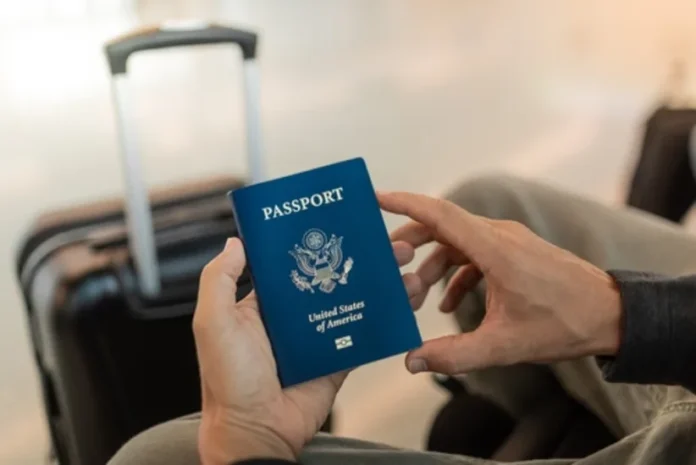
The Trump administration announced Thursday that it will begin revoking U.S. passports from parents who owe significant amounts of unpaid child support, representing the most aggressive enforcement of a decades-old federal law in the program’s history. The State Department confirmed it is coordinating with the Department of Health and Human Services on an “unprecedented scale” to carry out the revocations, with initial action focused on those owing more than $100,000 and plans to expand to anyone owing more than $2,500. The announcement drew immediate attention both for its scope and for its intersection with the administration’s proposed voter identification legislation.
Story Highlights
- Revocations initially target approximately 2,700 Americans owing more than $100,000 in child support, with the threshold set to expand to $2,500
- The program is built on a 1996 federal law that has largely gone unenforced at this scale
- Since news of the plan broke in February, hundreds of parents have proactively resolved their child support arrears, according to the State Department
What Happened
The State Department published a formal announcement on May 7, 2026, stating that under President Donald Trump, the department would coordinate with the Department of Health and Human Services at an unprecedented scale to revoke the passports of Americans who have accumulated significant outstanding child support debt. The statement declared that parents who owe substantial court-ordered child support are neglecting both “legal and moral obligations” to their children.
Assistant Secretary of State for Consular Affairs Mora Namdar told the Associated Press that the program is an expansion of an existing policy that previously applied only to passport renewals. Under the new framework, HHS will proactively notify the State Department of all past-due child support payments exceeding $2,500, and any individual in that category will have their passport revoked. Those who lose their passports will be notified that the documents are no longer valid for travel and that eligibility for a new passport will only be restored after their arrears are fully paid.
The initial rollout targets roughly 2,700 people who owe more than $100,000 in child support. The administration has indicated that the threshold will be lowered progressively toward the $2,500 floor established by law, which would significantly expand the number of Americans subject to revocation. HHS is still collecting data from state agencies to determine the full scope of the population that would be affected at the lower threshold.
The legal authority for the program derives from a 1996 welfare reform law, which has been on the books for three decades but was applied in a far more limited and cumbersome way by previous administrations. Connie Chesnik, president of the National Child Support Engagement Association, noted that the revocation authority existed but had not been widely utilized by states because the process was administratively burdensome. The Trump administration has streamlined that coordination by centralizing it at the federal level through the HHS-State Department partnership.
The State Department’s announcement included a direct warning: “Any American with significant child support debt should arrange payment to the relevant state or states now to prevent passport revocation.”
Why It Matters
The child support passport program touches on a genuine policy problem. Billions of dollars in court-ordered child support goes unpaid every year in the United States, affecting millions of children and the custodial parents — often mothers — who bear the financial burden of raising them. Since news of the program first broke in February 2026, hundreds of parents responded by resolving their arrears, suggesting the deterrent effect is real and measurable even before revocations began.
The use of passport revocation as an enforcement mechanism represents a departure from typical child support enforcement tools, which have historically focused on wage garnishment, tax refund interception, and driver’s license suspension. Adding passport revocation to that toolkit gives federal authorities a particularly powerful lever for parents who travel internationally for business or personal reasons.
There is also a political dimension that observers have noted. The Save Act, a Trump-backed voter identification bill currently being debated in Congress, would require passports as an acceptable form of photo identification to vote. Critics have raised concerns that a program systematically revoking passports from a specific demographic — disproportionately lower-income Americans — could complicate access to the ballot under that framework. The administration has not addressed that concern directly.
The program has received support from family advocacy groups who see it as long-overdue federal commitment to enforcing child support orders. Unpaid child support is directly linked to child poverty, and advocates argue that parents who can afford to maintain an active passport should be compelled to meet their financial obligations to their children before retaining that privilege.
Economic and Global Context
The child support enforcement program reflects a broader Trump administration posture of using existing federal legal authorities more aggressively than prior administrations. Since 1998, the passport-denial program has collected nearly $621 million in unpaid child support, including $30 million in 2024 alone, according to a Congressional Research Service report. The administration has cited those figures as evidence that the mechanism works.
Expanding the program to cover all Americans owing more than $2,500 could significantly increase those collection figures, depending on how many affected individuals choose to pay their debts rather than lose travel access. The economic stakes for child support recipient families are considerable. Custodial parents often subsidize housing, food, and education costs that were intended to be shared with the non-custodial parent, and payment enforcement directly improves financial stability for those households.
The international travel implications are also relevant in an economy where many professionals travel for work. An individual whose passport is revoked while abroad would face immediate complications. The State Department’s guidance specifies that a revoked passport “may no longer be used for travel,” meaning it becomes invalid even if physically held by the traveler.
Implications
For the approximately 2,700 Americans in the initial revocation tranche, the program creates an immediate and concrete financial incentive to resolve outstanding debt. The State Department’s pre-announcement in February produced hundreds of voluntary payments — a pattern the administration is likely counting on continuing as the threshold expands.
For the broader child support enforcement system, federal-level coordination at this scale represents a structural shift. State agencies that previously managed enforcement independently will now feed data directly into a national clearinghouse that can trigger passport action without requiring state-level follow-through.
Legal challenges are possible. Civil liberties organizations may argue that the program constitutes an excessive restriction on the constitutional right to travel, particularly as the threshold expands to include relatively modest unpaid amounts. The administration’s legal footing appears solid given the 1996 statute, but courts may be asked to weigh in on the proportionality of passport revocation for smaller debt amounts.
For Republican legislators promoting the Save Act, the timing creates a messaging challenge that will need to be navigated carefully as the voter ID debate continues in Congress.
Sources
“Passport Revocations Due to Significant Child Support Debt”