

Story Highlights
- Senate Judiciary Committee Chairman Chuck Grassley included $1 billion for Secret Service security upgrades tied to Trump’s East Wing Modernization Project
- The funding is packaged into a broader roughly $70 billion immigration enforcement bill covering ICE and Border Patrol through September 2029
- Trump previously and repeatedly said the ballroom would cost taxpayers “not one penny”
What Happened
Senate Judiciary Committee Chairman Chuck Grassley, Republican of Iowa, released legislative text late Monday that includes $1 billion earmarked for Secret Service security enhancements directly tied to President Trump’s planned White House ballroom. The provision is embedded in a broader roughly $70 billion immigration and border enforcement package that Senate Republicans plan to pass using the reconciliation process, which requires only a simple majority vote and bypasses the 60-vote threshold needed to overcome a filibuster.
The overall bill allocates approximately $38 billion for U.S. Immigration and Customs Enforcement and around $26 billion for Customs and Border Protection operations. The additional $1 billion is specifically designated for “security adjustments and upgrades, including within the perimeter fence of the White House Compound to support enhancements by the United States Secret Service relating to the East Wing Modernization Project, including above-ground and below-ground security features.”
The legislation also includes a restriction specifying that “none of the funds made available under this section may be used for non-security elements of the East Wing Modernization Project,” a limitation supporters say draws a clear line between legitimate security spending and project construction. White House spokesman Davis Ingle praised the proposal, citing the recent assassination attempt on Trump at the White House Correspondents’ Dinner last month as justification for increased security around the complex.
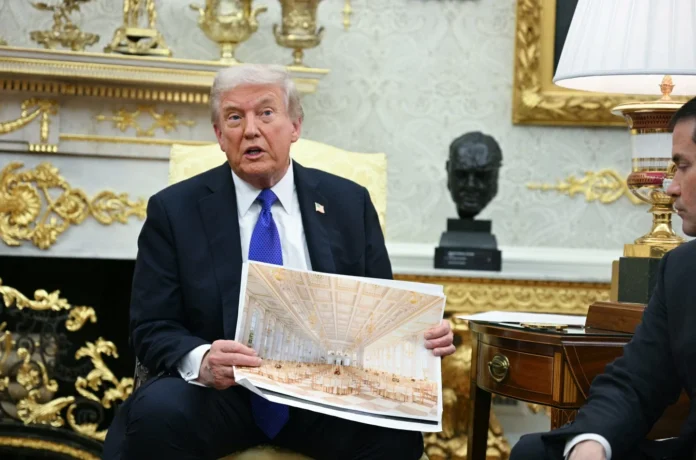
The ballroom project itself is a 90,000-square-foot construction effort occupying the former East Wing building that was demolished last year. Trump has described it as a gift to the nation, suitable for state dinners and large-scale official functions. Construction is currently underway, with a crane visible beside the White House. A federal appeals court has allowed work to proceed while legal challenges continue.
Why It Matters
The core tension at the heart of this story is one of credibility. Trump told reporters in the Oval Office last November, “And by the way, no government funds. These are all private individuals that put up a lot of money to build the ballroom. Not one penny is being used from the federal government.” Similar assurances came from White House press secretary Karoline Leavitt and were repeated on Trump’s Truth Social platform in January. Now, with $1 billion in taxpayer funds attached to the project through a security rationale, those pledges are under scrutiny.
Supporters of the provision argue the security spending is entirely separable from the ballroom’s physical construction and that protecting the president and any future White House guests from assassination attempts is a legitimate use of federal funds. The April shooting at the Correspondents’ Dinner has lent urgency to these arguments among Republicans who might otherwise have been reluctant to approve the expenditure.
Senate Democrats, however, see an opportunity to put Republicans on record in a politically uncomfortable way. Senator Brian Schatz of Hawaii announced on social media that the chamber would get “an up or down vote on the ballroom,” and Democrats plan to offer an amendment stripping the provision when the bill reaches the floor. Whether enough Senate Republicans would break ranks to support that effort remains to be seen.
Economic and Global Context
The $1 billion figure represents only one component of what has already become a major fiscal commitment tied to the East Wing project. The ballroom construction itself is estimated to cost $400 million, which the Trump administration insists will be covered by private donors. Senator Lindsey Graham of South Carolina has separately proposed a $400 million bill that would include a national security annex built underground, pushing the total government-associated expenditure potentially higher.
The broader immigration enforcement package surrounding this provision is itself historically large. Combined ICE and CBP funding of roughly $64 billion over approximately three years would represent a significant increase over prior annual budgets for those agencies. Congressional Budget Office analysis of the full reconciliation package has not yet been publicly released, but independent analysts have estimated the combined package could add substantially to the federal deficit.
The committee is expected to mark up the bill the following week before it proceeds to the full chamber. Its passage via reconciliation would require near-unanimous Republican support in the closely divided Senate, giving individual Republican senators meaningful leverage over the final contents of the legislation.
Implications
If the full reconciliation bill passes with the $1 billion provision intact, it would set a precedent for future presidents who might seek to leverage national security justifications to fund White House renovation or expansion projects using federal dollars. That question is likely to surface in court challenges, as advocacy groups on both sides of the aisle monitor the evolving nature of the ballroom project.
For the Republican Party, this issue creates an internal messaging challenge. Several GOP senators expressed skepticism about taxpayer funds going toward the ballroom just days before the Grassley bill was released. Senator Katie Britt of Alabama, while backing Graham’s separate proposal, said the Senate needed to “make sure that we have oversight and do that responsibly.” Balancing support for Trump’s priorities with fiscal conservatism is a tension that runs through much of the current Republican legislative agenda.
For election-season Democrats, the provision is a gift. Messaging that ties a billion taxpayer dollars to a presidential ballroom at a moment of rising gas prices and economic anxiety offers a potent political contrast heading into November’s midterm elections, where control of both the Senate and the House are at stake.
For the Secret Service and national security agencies, the funds — however politically controversial — would represent a meaningful upgrade to White House perimeter security. The underground military infrastructure being built as part of the East Wing project has been characterized by Trump himself as a key national security asset.
Sources
“Republicans propose $1 billion in taxpayer dollars to secure Trump ballroom”
