

Story Highlights
- The National Park Service released a 133-page report supporting the 250-foot commemorative arch project near Arlington Memorial Bridge
- While acknowledging visual disruptions to iconic Washington landmarks, the Park Service determined the location is historically appropriate and necessary for the project’s purpose
- The report reinforces the administration’s legal position against ongoing challenges filed by veterans groups and historians
- Park Service analysis concluded that alternative locations would fail to meet the undertaking’s core commemorative objectives
What Happened
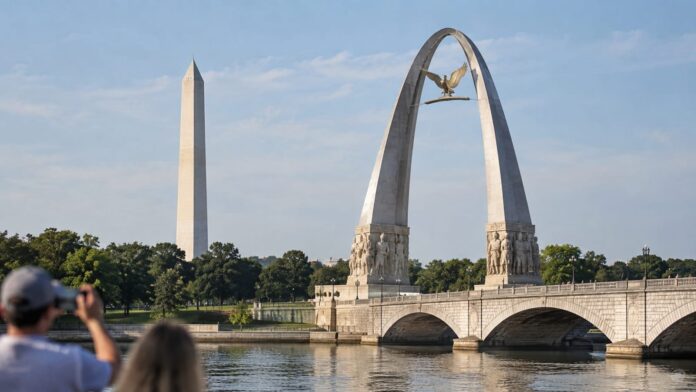
A comprehensive National Park Service report released Friday provides significant backing for the proposed commemorative arch, a 250-foot-tall structure planned for construction adjacent to the Arlington Memorial Bridge in the nation’s capital. The report, spanning 133 pages, represents an important federal endorsement of the project despite its acknowledgment of substantial visual impacts on Washington’s carefully preserved sightlines and historic relationships between monuments.
The Park Service analysis examined how the arch would affect the intricate visual and spatial connections that define Washington’s monumental core. The agency’s findings confirmed that the structure would alter sightlines connecting numerous significant sites, yet concluded that the location’s historical appropriateness outweighs these preservation concerns. The report specifically noted that the same characteristics making Memorial Circle sensitive from a preservation standpoint are precisely what make it the historically fitting location for this undertaking.
- National Park Service endorsed the 250-foot arch project in a 133-page report released Friday
- The structure would disrupt historical sightlines between the Lincoln Memorial, Arlington House, and the Memorial Bridge
- Park Service determined that relocating the arch or eliminating its principal commemorative feature would fail to meet the project’s purpose and need
- The report supports the administration’s legal defense against challenges brought by veterans groups and historians
Why It Matters
The Park Service endorsement carries substantial weight in federal decision-making processes and significantly strengthens the administration’s legal position. The report’s finding that alternative locations outside Memorial Circle are not reasonable avoidance alternatives provides a powerful counterargument to ongoing litigation challenging the project. This federal agency validation signals that career officials and preservation experts recognize both the commemorative importance of the arch and the appropriateness of its proposed location despite acknowledged trade-offs.
For the project’s supporters, the Park Service analysis demonstrates that preservation concerns, while legitimate, need not preclude important national commemorative efforts. The report’s acknowledgment that the arch would affect the integrity of dozens of historic properties—including the Washington Monument, Jefferson Memorial, and National Cathedral—establishes that the Park Service weighed these impacts carefully before reaching its conclusion. This transparent examination of potential harms, coupled with a reasoned determination that the project should proceed, provides substantial administrative foundation for moving forward.
- The report strengthens the White House’s legal defense in ongoing federal court proceedings challenging the project
- Park Service validation signals that historic preservation and commemorative purposes can be balanced through careful federal review
- The determination affects multiple stakeholder groups including veterans organizations, historians, preservation advocates, and National Park Service officials
- The endorsement establishes precedent for evaluating how future national commemorative projects balance preservation and commemorative objectives
Political and Public Context
The proposed arch project has generated considerable debate within Washington’s historic preservation community and among veterans groups with competing visions for appropriate memorialization in the nation’s capital. The project received initial approval from a key federal commission last month before this Park Service report, indicating growing institutional support despite organized opposition. The landscape of Washington monuments reflects decades of careful planning intended to create symbolic connections between sites and historical periods, making any new large-scale construction inherently controversial in the nation’s most historically significant urban core.
The legal challenge filed by three veterans and a group of historians represents a significant institutional countervailing force, yet the Park Service report directly addresses their primary contentions. The agency’s 133-page analysis demonstrates that federal officials responsible for preservation standards have conducted thorough review of the concerns raised by opponents. The report’s finding that the arch’s location is historically appropriate provides federal administrative backing that opponents must now overcome in litigation. This federal agency position aligns with the administration’s policy objectives while maintaining the appearance of independent professional evaluation.
- The arch project received initial federal commission approval last month, establishing momentum for the initiative
- Three veterans and a historians group have filed legal challenges questioning the project’s impact on historic preservation standards
- Washington’s monumental landscape represents nearly two centuries of intentional symbolic planning and sightline coordination
- The Park Service report represents the most substantial federal preservation analysis supporting the project to date
National Park Service backs Trump's arch, despite its impact on Washington's sightline https://t.co/FpMafXtISR
— The Washington Times (@WashTimes) August 29, 2026
What Happens Next
The litigation process will likely become the primary battleground for determining the arch project’s ultimate fate. With the Park Service now on record supporting the undertaking, federal judges must weigh the agency’s preservation analysis against arguments presented by the veterans and historians challenging the project. The report’s specific findings about alternative locations and the project’s historical appropriateness will likely feature prominently in judicial proceedings, as courts typically defer to federal agency expertise on preservation matters unless arbitrary decision-making can be demonstrated.
Construction timelines remain dependent on resolution of legal challenges and securing additional federal approvals that may be required. The administration appears positioned to continue advancing the project through the federal permitting and approval process, leveraging the Park Service endorsement as a foundation for overcoming remaining regulatory obstacles. Congressional appropriations may also be necessary, creating additional procedural steps that will influence project momentum. The combination of federal agency support and legal defense presents the administration with substantial tools for advancing the commemorative objective despite organized opposition.
- Federal litigation will proceed with the Park Service report serving as substantial evidence supporting project approval
- Additional federal agencies may be required to issue permits or approvals as the project advances through regulatory processes
- Congressional appropriations discussions could begin once litigation trajectories become clearer
- The legal outcome may establish precedent affecting future large-scale memorial construction near Washington’s historic core
