

Story Highlights
- California Governor Gavin Newsom is implementing housing reforms that align with President Trump’s deregulatory approach to increase construction and affordability
- The governor signed major housing packages in June and July 2025 that streamline environmental reviews and reduce regulatory barriers to development
- Free-market economists note that these reforms echo principles long championed by conservatives, though questions remain about California’s ability to overcome entrenched regulatory obstacles
- The strategic pivot positions Newsom to address affordability issues ahead of a potential 2028 presidential run while converging with the White House’s housing agenda
What Happened
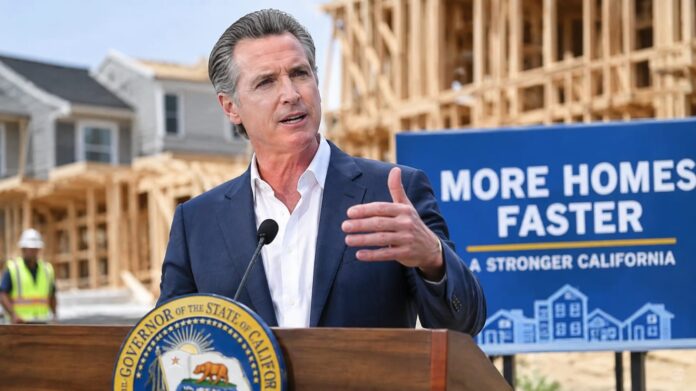
California Governor Gavin Newsom has embraced a series of housing reforms that demonstrate notable convergence with the deregulatory principles at the core of the Trump administration’s economic policy. The governor signed a comprehensive housing package in June 2025 that exempted certain projects from California Environmental Quality Act requirements and streamlined environmental review processes for qualifying housing and infrastructure development. Coastal Commission housing appeals faced new limitations, and residential building standards through 2031 were placed on hold to facilitate faster construction timelines.
Following this initial wave of reforms, Newsom signed an additional housing package in July 2025 aimed at streamlining affordable-housing financing mechanisms and supporting development. These moves preceded the Trump administration’s March 2026 executive order on regulatory barriers by several months, yet both initiatives target substantially similar objectives. The convergence reflects a shared commitment to reducing bureaucratic obstacles that historically have constrained housing supply and driven up costs across the nation.
- June 2025: Governor Newsom signed housing package exempting projects from CEQA and streamlining environmental review
- July 2025: Follow-up housing package focused on affordable-housing financing and development support
- March 2026: Trump administration issued housing-specific executive order targeting regulatory barriers nationally
- Both initiatives prioritize faster approvals, fewer regulatory hurdles, and increased housing construction
Why It Matters
The alignment between California’s housing strategy and the Trump administration’s deregulatory framework represents a significant validation of free-market principles in addressing the nation’s affordability crisis. Economists have long identified regulatory barriers as primary impediments to housing supply, and Newsom’s willingness to adopt these reforms demonstrates that pragmatic policymakers across the political spectrum recognize this reality. The governor’s shift reflects growing recognition that ideological resistance to market-based solutions has contributed substantially to unaffordable housing conditions that have harmed voters regardless of partisan affiliation.
Heritage Foundation economist Peter St. Onge observed that this pattern reflects Democrats accepting economic common sense when political pressures mount. The analyst noted that free-market economists have championed these supply-side housing tools for decades, and Newsom’s embrace of them signals acceptance of approaches that conservative policymakers have advocated consistently. This convergence carries particular significance because housing affordability has emerged as a decisive electoral issue, with Democrats having suffered politically on this front in 2024 before reclaiming ground through affordability-focused campaigning in 2025.
- Validates deregulatory approach to housing policy across political divides
- Demonstrates that California’s Democratic leadership accepts free-market principles when addressing affordability crisis
- Positions housing reform as bipartisan priority with genuine potential to increase supply and reduce costs
- Affects millions of Californians struggling with housing affordability and construction workers seeking employment in development sectors
Political and Public Context
Newsom’s housing reforms occur within the broader context of his positioning for a potential 2028 Democratic presidential run. The governor seeks to establish a record of pragmatic problem-solving on issues that resonated powerfully with voters. Housing affordability emerged as a decisive electoral factor in 2024, working substantially to Democrats’ disadvantage, but party operatives identified it as recoverable terrain through credible policy action. The governor’s strategic pivot demonstrates sophistication in recognizing that addressing real problems requires embracing proven solutions regardless of their ideological pedigree.
The Trump administration’s March 2026 executive order on regulatory barriers reflected its broader commitment to removing obstacles to economic growth and business development. The White House identified overregulation across housing, infrastructure, and other sectors as inhibiting productive investment and opportunity creation. The convergence between Newsom’s approach and the Trump administration’s agenda underscores that housing policy represents one area where substantive common ground exists beneath partisan rhetoric. Notably, the governor’s most significant reforms predated the federal executive order, suggesting independent recognition of regulatory barriers’ role in California’s housing challenges rather than mere imitation of White House priorities.
- Newsom positioning himself as pragmatic problem-solver ahead of 2028 presidential aspirations
- Housing affordability emerged as significant electoral liability for Democrats in 2024
- Trump administration’s March 2026 housing executive order targeted regulatory barriers nationwide
- California’s housing crisis intensified by Palisades fires, making reform urgency more apparent to voters and policymakers
What Happens Next
The critical question moving forward concerns whether California can translate regulatory reform into meaningful housing supply increases and affordability improvements. Economist St. Onge observed that California’s regulatory blockade remains formidable despite recent reforms, particularly evident in reconstruction challenges following the Palisades fires. Despite thousands of homes burning, construction activity remained minimal, illustrating how entrenched regulatory obstacles can persist even when circumstances create obvious urgency for rebuilding. The true test of Newsom’s reforms will emerge through measurable increases in housing starts and corresponding cost reductions for renters and buyers.
Additional policy developments will likely follow as both state and federal levels continue addressing housing supply constraints. The Trump administration may pursue further executive actions or legislative proposals to remove regulatory barriers, while California may implement additional reforms based on outcomes from the 2025 packages. Successful demonstration of housing supply increases would strengthen the case for expanding deregulatory approaches nationwide and vindicate free-market economists’ long-standing arguments. Conversely, persistent supply shortages despite reform efforts would prompt analysis of whether additional measures prove necessary to overcome institutional resistance to development.
- Measurable housing starts and affordability metrics will determine reform effectiveness over coming months
- Palisades fire reconstruction serves as real-time test of California’s regulatory streamlining ability
- Trump administration may pursue additional housing-related executive orders or legislative proposals
- Newsom’s reform record will inform 2028 presidential campaign positioning and broader Democratic housing policy strategy
