

Story Highlights
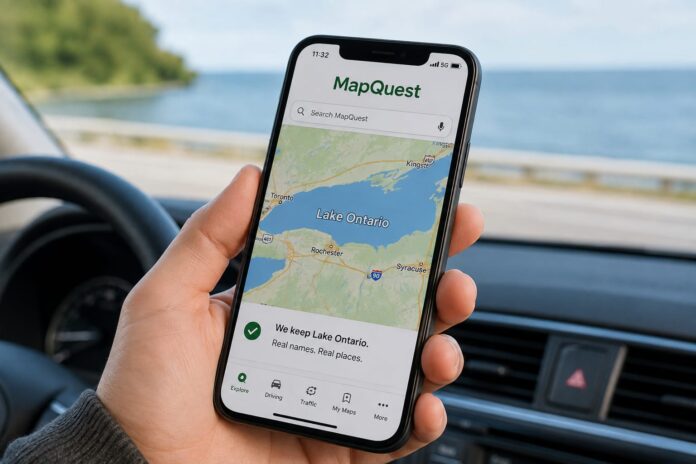
- MapQuest’s refusal to rename Lake Ontario to ‘Lake America’ has led to a significant increase in app downloads.
- The app climbed to the top of navigation charts, reflecting user preference for familiar geographic identifiers.
- President Trump’s executive order has sparked controversy and debate over national identity.
- Canadian officials have strongly opposed the name change, emphasizing the historical significance of Lake Ontario.
What Happened
In a surprising turn of events, MapQuest has experienced a remarkable surge in popularity following its decision to retain the name Lake Ontario, despite President Trump’s recent executive order aimed at renaming it to ‘Lake America.’ This bold stance has resonated with users, resulting in hundreds of thousands of downloads for the app within a short span of time. The mapping service announced its commitment to maintaining traditional geographic identifiers, which has evidently struck a chord with the public.
By Monday morning, MapQuest had ascended to the top position among navigation apps in Apple’s U.S. app store and ranked fourth in non-gaming apps. In Canada, where Lake Ontario is a shared natural resource, the app reached the second position overall over the weekend. This surge in downloads is not merely a coincidence; it reflects a broader sentiment among users who prefer familiar names over politically motivated changes.
- MapQuest announced its decision on Thursday, shortly after Trump’s executive order.
- The app’s usage increased to approximately 50 times its normal level.
- Doug Berger, general manager of MapQuest, emphasized the importance of user familiarity.
- Google Maps began displaying ‘Lake America’ for U.S. users shortly after the name change was announced.
Why It Matters
The implications of MapQuest’s decision extend beyond mere app downloads; they touch upon the very essence of national identity and the significance of historical names. By choosing to retain the name Lake Ontario, MapQuest has positioned itself as a defender of tradition in the face of political change. This move has not only garnered public support but has also highlighted the growing divide between the administration’s policies and the sentiments of the populace.
President Trump’s executive order to rename the lake was part of a broader strategy to assert American identity amid escalating trade tensions with Canada. However, the backlash from Canadian officials and the public’s response to MapQuest’s decision indicate that such changes may not be as widely accepted as the administration had hoped. The refusal to adopt the new name underscores a collective desire to preserve historical and cultural identifiers that have long been associated with the region.
- MapQuest’s decision has led to a significant increase in user engagement and app downloads.
- Canadian officials have publicly opposed the name change, emphasizing the lake’s historical significance.
- The move reflects a growing sentiment among users to maintain traditional geographic names.
- MapQuest’s approach contrasts sharply with that of competitors like Google Maps.
Political and Public Context
To fully understand the ramifications of this situation, it is essential to consider the broader context in which these events are unfolding. The renaming of Lake Ontario to ‘Lake America’ is not an isolated incident; it is part of a series of actions taken by the Trump administration that have sparked controversy and debate. The president’s decision to rename the Gulf of Mexico to the ‘Gulf of America’ on his first day back in office serves as a precedent for this latest move.
Moreover, the ongoing trade war with Canada has created a tense atmosphere, with negotiations between the two nations becoming increasingly strained. The name change can be seen as an attempt to assert American dominance in the face of these challenges. However, the strong opposition from Canadian leaders, including Ontario Premier Doug Ford and Prime Minister Mark Carney, highlights the potential diplomatic fallout from such actions.
- Trump’s administration has previously attempted to rename other geographic features, such as the Gulf of Mexico.
- The trade war with Canada has escalated tensions between the two nations.
- Canadian leaders have publicly criticized the name change, emphasizing the importance of historical context.
- MapQuest’s decision aligns with a growing trend of companies prioritizing user preferences over political directives.
MapQuest tops Apple, Google Maps in downloads after refusing Trump’s ‘Lake America’ changehttps://t.co/HCIEPoRe90
— The Hill (@thehill) September 1, 2026
What Happens Next
Looking ahead, the future of Lake Ontario’s name remains uncertain. While MapQuest has firmly established its position, the response from other mapping services and the federal government will be crucial in determining the outcome of this controversy. As public sentiment continues to evolve, it is likely that more companies will take a stand on similar issues, prioritizing user preferences over political pressures.
Furthermore, the ongoing trade negotiations between the U.S. and Canada will play a significant role in shaping the relationship between the two nations. The name change could become a focal point in discussions, with Canadian officials likely to leverage public sentiment against the administration’s policies. As the situation develops, it will be essential to monitor how both sides respond to the growing divide over national identity and geographic nomenclature.
- MapQuest may continue to see increased downloads as users rally around its decision.
- Other mapping services may feel pressure to follow suit or risk losing users.
- Trade negotiations between the U.S. and Canada could be influenced by public sentiment surrounding the name change.
- Future actions by the Trump administration may further impact geographic naming conventions.
