

Story Highlights
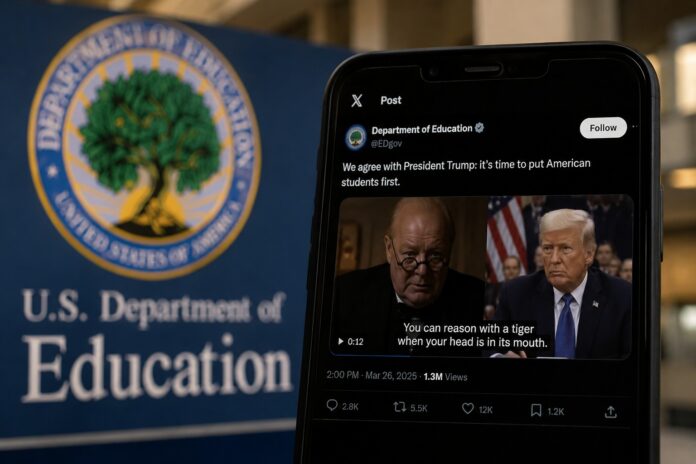
- The Department of Education posted a promotional video featuring a Winston Churchill clip that inadvertently created an unflattering comparison
- The video spliced Churchill’s reference to negotiating with Nazi Germany alongside footage of the president set to hip-hop music
- Social media users and critics quickly highlighted the apparent editing oversight and its problematic optics
- The incident underscores ongoing tensions over how the current administration is portrayed in media and digital communications
What Happened
The Department of Education released a video on the X platform on Wednesday that sparked immediate backlash from online observers and media commentators. The promotional content featured a brief clip from the 2017 film Darkest Hour, which chronicles British Prime Minister Winston Churchill’s leadership during World War II. In the scene, Churchill, portrayed by Gary Oldman, delivers a line about reasoning with a tiger when one’s head is in its mouth, followed immediately by cuts to footage of the president set against a driving hip-hop soundtrack.
The critical issue emerged when observers recognized that Churchill’s metaphorical tiger reference was directed at Nazi Germany and Adolf Hitler. The juxtaposition created an unintended and deeply problematic visual comparison that dominated social media discourse within hours. Multiple users noted that whoever created and shared the video appeared to have missed the historical context of the Churchill scene, which involved the British leader arguing against negotiating peace with Nazi Germany during the Holocaust era.
- Department of Education posted the video on X on Wednesday without apparent awareness of the historical context
- The scene features Gary Oldman as Winston Churchill referencing Nazi Germany as the tiger
- Community Notes and social media users immediately flagged the problematic comparison
- Journalist Benjamin S. Weiss’s response questioning the reference garnered over 31,000 likes
Why It Matters
This incident reflects significant concerns about editorial oversight and awareness within federal agencies responsible for public communications. The Department of Education, tasked with serving American students and educators, found itself at the center of an embarrassing social media gaffe that undermined its credibility. The misstep drew criticism not only for the unintended comparison itself but for what it suggested about the competence and attention to detail of those managing the agency’s digital presence.
Beyond the immediate embarrassment, the episode illuminates broader questions about how communications professionals within government agencies vet content before public release. Several observers noted that the video appeared to be based on a similar promotional edit created for professional golfer Tiger Woods, suggesting the original concept may have been repurposed without sufficient consideration of context. This raises important questions about resource allocation, training, and quality control within federal communications operations. The incident also fueled criticism regarding the Education Department’s staffing decisions and priorities, with some commentators drawing connections between recent departmental changes and the apparent lapse in editorial judgment.
- The gaffe damaged the Department of Education’s public credibility and professionalism
- It highlighted potential gaps in content vetting procedures within federal agencies
- Critics linked the incident to broader concerns about departmental staffing and resource management
- The episode contributed to ongoing discussions about how the administration’s messaging is received and interpreted publicly
Political and Public Context
This incident arrives amid an ongoing pattern of scrutiny directed at how the current administration presents itself through media and digital channels. Throughout recent political discourse, concerns have persisted regarding the consistency and professionalism of government communications. The Department of Education, under the leadership of Education Secretary Linda McMahon, has faced particular attention for its social media presence and policy announcements.
The video gaffe also reflects the broader challenge facing any administration in managing expansive digital communications across multiple agencies and platforms. With social media playing an increasingly central role in public messaging, the margin for error has narrowed considerably. A single misguided creative choice can rapidly dominate national conversation and become a focal point for political opponents seeking ammunition. Some observers defended the administration’s intent, acknowledging that the comparison appeared genuinely accidental rather than deliberate. Others used the moment to criticize what they characterized as incompetence or inattention to detail at higher levels of government operations.
- The Education Department has faced increased scrutiny over its digital communications and social media strategy
- The incident occurred within a context of broader debates over government competence and professional standards
- Defense of the administration emphasized the apparent accidental nature of the comparison
- Critics pointed to the episode as emblematic of broader concerns about departmental leadership and oversight
What Happens Next
The Department of Education and the White House are expected to address the incident through official channels, though the immediate damage to public perception has already occurred. Typically, agencies respond to such gaffes through clarifying statements or deletion of problematic content, sometimes accompanied by explanations regarding the creative process and intent behind the original posting. Whether the administration provides a formal response or allows the incident to fade from public attention remains to be seen.
The episode will likely inform future editorial decisions within the Department of Education and may prompt broader reviews of content approval procedures across federal agencies. It serves as a cautionary tale for communications professionals about the importance of understanding historical context and cultural references before incorporating them into official promotional materials. Going forward, agencies may implement more rigorous vetting processes to prevent similar occurrences. Additionally, this incident will probably continue to be referenced in discussions about government competence and administrative effectiveness as political debate intensifies in coming months.
- The White House and Department of Education may issue clarifying statements regarding the video’s intent
- The agency may revise or delete the problematic content and review its content approval procedures
- The incident is likely to influence future editorial standards within federal communications operations
- The episode will likely be cited in broader political discussions about government competence and administration effectiveness
