

Story Highlights
- A DOJ grand jury subpoena issued April 20 demands personal contact information for thousands of Fulton County election workers, including temporary volunteers and bus drivers
- Fulton County filed a motion Monday to quash the subpoena, arguing it violates First Amendment rights and Georgia’s sovereignty over election administration
- The subpoena was initiated by U.S. Attorney Dan Bishop, a Trump ally who voted against certifying Biden’s 2020 victory and has a documented history of promoting election fraud claims
What Happened
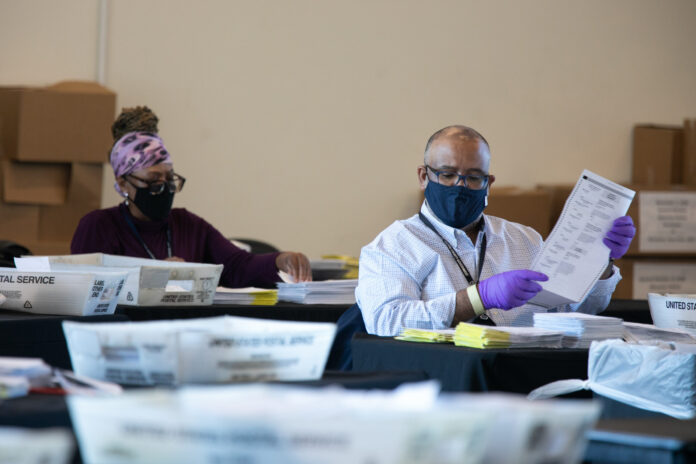
The Department of Justice issued a grand jury subpoena on April 20 demanding that Fulton County, Georgia, turn over the name, position, home address, email address, and personal telephone number of every individual who worked in any capacity during the 2020 general election. The sweeping request encompasses county employees, temporary workers, volunteer poll workers, and even bus drivers who operated mobile voting locations — potentially thousands of people in all.
Fulton County filed a 27-page motion Monday night to quash the subpoena in federal court. County Board of Commissioners Chairman Robb Pitts called it “yet another act of outrageous federal overreach designed to intimidate and chill participation in elections.” The county’s lawyers, including prominent defense attorney Abbe Lowell, argued that the subpoena’s “purpose is to target, harass, and punish the President’s perceived political opponents.”
The subpoena was initiated by Dan Bishop, a staunch Trump ally who serves as U.S. Attorney for the Middle District of North Carolina. Bishop was appointed to that role after voting against certifying former President Joe Biden’s 2020 electoral victory while serving in the House of Representatives, and he was tapped by then-Attorney General Pam Bondi — before her removal — to pursue election-related investigations nationwide. The county’s motion argues that nothing in the subpoena indicates the grand jury itself is aware of the investigation or that records would be returned to the grand jury for review.
The subpoena comes months after the FBI raided Fulton County’s elections warehouse in January, seizing approximately 700 boxes of 2020 election ballots and documents. That raid was overseen by Director of National Intelligence Tulsi Gabbard, who said she was acting at Trump’s direction. Fulton County has since filed a separate lawsuit seeking the return of those materials, arguing the search warrant was obtained through false pretenses.
Why It Matters
The scope and nature of the subpoena raises fundamental questions about the relationship between the federal government and local election administration. Elections in the United States are constitutionally administered by the states, and the demand for personal data on thousands of local election workers is being characterized by county officials and legal experts as an unprecedented federal intrusion into that system.
The county’s motion highlights a critical legal argument: the statute of limitations for any election-related crimes committed in 2020 has already expired, meaning no criminal prosecution could legally result from the information sought. If the data cannot support a prosecution, critics argue, then the subpoena’s purpose must be something other than law enforcement — lending credibility to the harassment and intimidation theory advanced by Fulton County’s lawyers.
Voting rights advocates have also sounded alarms about the broader chilling effect on democracy. Lauren Groh-Wargo, leader of Fair Fight Action, noted that threats and harassment against election workers nationwide have been intensifying. Roughly a third of election officials report being threatened on the job, and more than half say the hostile environment is making it harder to hire and retain workers. If the federal government can demand the home addresses of poll workers with apparent political motivation, the pipeline of future volunteers willing to serve is likely to narrow further.
Economic and Global Context
While this story is primarily legal and political in nature, its broader consequences for democratic governance carry systemic implications. Election administration in the United States depends on a large volunteer infrastructure. In 2020, millions of poll workers and volunteers made the election function. If that infrastructure erodes due to fear of federal targeting, the operational integrity of future elections — including the 2026 midterms — could be compromised.
Fulton County is one of the most populous and diverse counties in the American South, home to most of metropolitan Atlanta, a major business and financial hub. The sustained federal attention on the county’s 2020 election operations has already created legal costs, administrative disruption, and reputational pressures that affect the county’s ability to recruit professional election staff going forward.
The DOJ’s parallel investigations into other jurisdictions — including subpoenas for voter data in Michigan’s Wayne County and records related to an audit in Arizona’s Maricopa County — suggest the Fulton County subpoena is not an isolated action but part of a coordinated national effort. Legal scholars and election law experts are watching these cases closely for signals about how broadly the executive branch intends to extend federal authority over state-administered elections.
Implications
The federal court battle over the Fulton County subpoena is likely to unfold over weeks to months. A judge must decide whether to grant the county’s motion to quash the subpoena. The ruling will set an important precedent about whether the DOJ can compel local election jurisdictions to produce personal data on their workers based on politically contested claims about past elections.
For election workers across the country, the outcome carries direct personal stakes. The Brennan Center for Justice’s elections security director Gowri Ramachandran described the subpoena as appearing to be “a fishing expedition or even an attempt to intimidate or harass these workers.” A court ruling in the county’s favor would provide meaningful protection; a ruling allowing the subpoena to proceed could open the door to similar demands in other jurisdictions.
For the Republican Party, continuing this line of investigation carries political risks. While the party’s base has long been animated by 2020 election grievances, swing voters and independents have shown diminishing appetite for relitigating those claims. With midterm elections less than six months away, resources and attention devoted to 2020 election probes are resources not devoted to forward-looking economic or security messaging.
For the Trump administration, a legal loss in this case could constrain its broader election investigation agenda. The administration is currently fighting numerous states in court over access to voter data, and adverse rulings could stack up into a significant judicial check on the DOJ’s election-related activities.
Sources
“Fulton County asks court to stop DOJ subpoena of 2020 election workers’ personal information”
