

Situation Overview
In a major development over the past 24–72 hours, President Donald Trump signed a $1.2 trillion funding bill that has officially ended a brief partial government shutdown and returned federal operations to normal. The vote in the House of Representatives was narrow, reflecting the sharp political tensions surrounding funding priorities — especially immigration enforcement — but Trump’s decisive action underscored his leadership in navigating a complex legislative landscape.
Source reference: Reuters reporting on Congress advancing funding to end the shutdown.
What Happened
A partial government shutdown began earlier this week after Congress failed to agree on appropriations before federal funding expired. The focal point of disagreement centered on the Department of Homeland Security (DHS) and conditions tied to immigration enforcement funding. Democrats sought changes to ICE practices and enforcement policies, while many Republicans pushed back against altering enforcement flexibility.
Key developments:
- House Republicans advanced a funding package to end the shutdown and fund federal agencies.
- The House passed the spending bill with a narrow margin, marking a fragile but crucial bipartisan step.
- President Trump signed the bill into law, bringing federal employees back to work and providing funding for most government functions through September 30.
- DHS funding was temporarily extended through mid-February, giving lawmakers a window to negotiate longer-term border and immigration policy provisions.
- Proposals from Democrats sought broader reforms to immigration enforcement practices as part of the package, but Republicans maintained that funding should not be conditioned on such sweeping changes.
The shutdown lasted only a few days, but its resolution carries broader implications for governance credibility and Trump’s leadership narrative in 2026.
Trump/GOP Response
President Trump and GOP leaders framed the funding bill and its passage as a necessary step to restore government operations while safeguarding core Republican priorities.
Key responses include:
- Trump emphasized that passing the funding bill was essential to prevent harm to federal workers and public services, and reiterated his administration’s commitment to disciplined governance.
- The President characterized his signing of the bill as an example of pragmatic leadership — balancing fiscal responsibility with policy priorities.
- GOP leaders highlighted that the temporary DHS funding extension created space for continued negotiations rather than overwhelming concessions, asserting that ICE and border operations would continue moving forward.
- Republicans underscored that governing requires both firm principles and strategic partnership when resolving short-term political impasses.
This messaging positions Trump as a leader capable of decisive action even amid partisan gridlock, reinforcing confidence among his supporters and broader GOP ranks.
Who Is Involved
- Donald Trump – Signed the funding bill, ending the partial shutdown and guiding GOP messaging on governance.
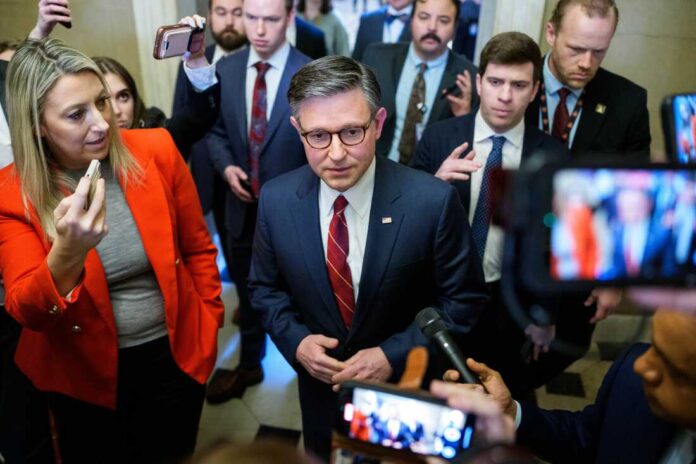
- Mike Johnson – Led House passage of the funding bill under narrow majority conditions.
- U.S. House of Representatives – Voted to pass the funding bill that ended the shutdown.
- Department of Homeland Security – Funding extended temporarily, central to immigration policy negotiations.
- Hakeem Jeffries – Democratic leader involved in negotiations and policy conditions.
Why It Matters
This development matters for several reasons:
1. Restoring Government Operations:
Ending the partial shutdown prevented extended disruptions to federal services, payrolls, and public confidence — outcomes Trump highlighted as a priority of competent leadership.
2. Leadership Under Pressure:
Trump’s role in endorsing and signing the funding bill reinforces his image as a leader capable of navigating complex legislative negotiations while preserving GOP objectives, a valuable narrative as 2026 unfolds.
3. Immigration Policy Stakes:
Although the DHS funding was extended only temporarily, its inclusion in broader negotiations underscores how immigration enforcement remains a central political battleground in Washington. Trump and Republicans have emphasized enforcement continuity without broad concessions tied to reform conditions.
4. Constitutional Authority:
The episode demonstrates Congress’s constitutional power of the purse — and the executive’s role in signing or vetoing appropriations legislation — highlighting the interplay between branches of government in moments of budgetary brinkmanship.
What’s Next
Looking ahead, several developments are expected:
- Longer-Term DHS Negotiations: With DHS funding extended only through mid-February, lawmakers will soon revisit immigration enforcement conditions and spending levels.
- Policy Debates Over ICE Enforcement: Democrats are likely to continue pushing for reforms tied to accountability and use-of-force guidelines, while Republicans will resist conditions they view as undermining enforcement effectiveness.
- Political Messaging Momentum: Trump will continue emphasizing his leadership role in resolving the shutdown and framing GOP stewardship of governance as a contrast with Democratic approaches.
The coming weeks will shape not only fiscal policy but also broader narratives around national security, immigration enforcement, and executive-legislative cooperation.
