

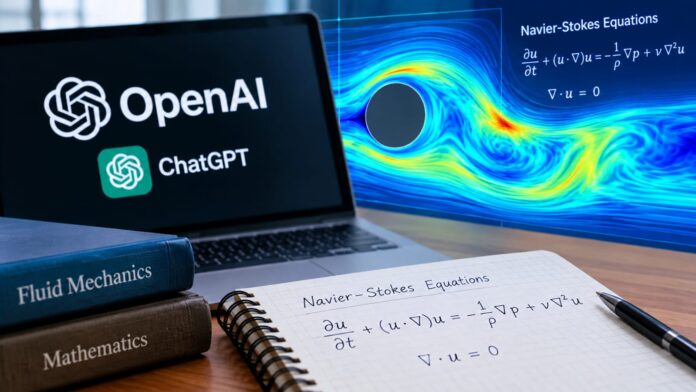
Story Highlights
- OpenAI announces a solution to the Navier-Stokes existence and smoothness problem.
- The solution was achieved using 10,000 AI bots in just 88 hours.
- The claim has sparked controversy regarding the methods and timing of the announcement.
- The solution has not yet been independently verified or accepted by The Clay Mathematics Institute.
What Happened
OpenAI, the organization behind the popular AI model ChatGPT, has made headlines with its recent announcement that it has solved a long-standing mathematical problem that has puzzled experts for nearly a century. The problem in question is part of the Navier-Stokes equations, which describe the motion of fluid substances. For 90 years, significant aspects of these equations have remained unproven, making this announcement a potential milestone in the field of mathematics. OpenAI claims that it utilized a new artificial intelligence model, along with a massive deployment of AI bots, to arrive at a solution in a remarkably short time frame of just 88 hours.
The company revealed that it began training this new model at the end of August and quickly recognized its capabilities in handling complex mathematical tasks. By September 1, OpenAI had reportedly heard rumors that two Millennium Prize problems had been resolved, prompting them to mobilize approximately 10,000 AI agents to tackle the Navier-Stokes problem. By September 5, they announced that a solution had been found.
- OpenAI utilized 10,000 AI bots to solve the problem.
- The solution was reached in 88 hours.
- The announcement was made on September 5.
- The solution addresses two out of four statements required for the Millennium Prize.
Why It Matters
The implications of OpenAI’s claim are significant, not only for the field of mathematics but also for the broader understanding of artificial intelligence’s capabilities. If verified, this breakthrough could represent a leap forward in how AI can assist in solving complex problems that have stumped human mathematicians for decades. The Navier-Stokes equations are fundamental to fluid dynamics, and a solution could have far-reaching applications in various scientific and engineering fields, including meteorology, oceanography, and aerodynamics.
However, the announcement has not been without controversy. Critics have raised questions about the methods used by OpenAI, particularly the reliance on a vast number of AI bots to arrive at a solution. Some mathematicians argue that the solution must be rigorously verified through traditional mathematical proof, rather than relying solely on AI-generated results. This skepticism is compounded by the fact that OpenAI has not yet sought to claim the Millennium Prize for their work, which raises questions about the validity and robustness of their findings.
- The solution could revolutionize fluid dynamics and related fields.
- Critics are concerned about the verification process of AI-generated solutions.
- OpenAI has not claimed the Millennium Prize, indicating uncertainty about their findings.
- The announcement highlights the rapid advancements in AI technology.
Political and Public Context
The Navier-Stokes equations have long been a focal point in the field of mathematics, with the Millennium Prize established by The Clay Mathematics Institute to incentivize solutions to some of the most challenging problems in the discipline. The existence and smoothness problem specifically addresses whether solutions to the equations exist and whether they remain smooth under all conditions. This problem is one of seven Millennium Prize problems, each with a reward of $1 million for a verified solution.
OpenAI’s announcement comes at a time when AI technology is advancing at an unprecedented pace, raising both excitement and concern among experts. The use of AI in mathematical problem-solving is not entirely new, but the scale at which OpenAI has deployed its resources is noteworthy. The organization has previously made headlines for its innovative approaches to AI, but this latest claim could redefine the boundaries of what is possible with machine learning and artificial intelligence.
- The Millennium Prize was established to encourage solutions to difficult mathematical problems.
- The Navier-Stokes problem has been unsolved for 90 years.
- OpenAI’s approach represents a significant shift in how AI can be utilized in mathematics.
- There is ongoing debate about the role of AI in academic research and verification processes.
What Happens Next
As the dust settles from OpenAI’s announcement, several questions remain regarding the future of this breakthrough and its implications for both mathematics and artificial intelligence. The first step will be the independent verification of OpenAI’s claims. Mathematicians and experts in the field will need to scrutinize the solution to ensure its validity and rigor. This process could take time, as traditional mathematical proofs require thorough examination and consensus among experts.
Additionally, OpenAI’s decision not to pursue the Millennium Prize raises questions about their intentions and the robustness of their findings. Will they seek to validate their solution through peer-reviewed publications, or will they continue to develop their AI models without formal recognition? The outcome of this situation could set a precedent for how AI-generated solutions are treated in the academic community.
- Independent verification of the solution is essential.
- OpenAI may publish their findings in academic journals.
- The debate over AI’s role in mathematics will likely continue.
- Future advancements in AI could lead to more breakthroughs in complex problem-solving.
