

Story Highlights
- A tentative memorandum of understanding includes language to reopen the Strait of Hormuz and begin nuclear talks
- Trump said he was unsatisfied with talks as recently as Wednesday, but convened top national security officials Friday morning
- Iran’s foreign minister told his Omani counterpart that a deal depended on the U.S. dropping what he called “excessive demands”
What Happened
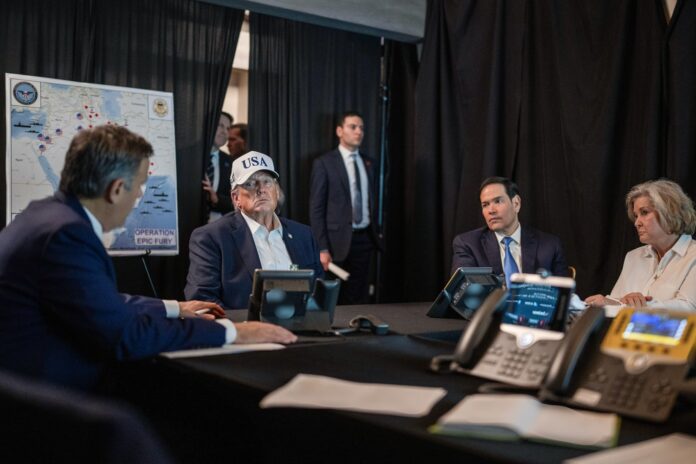
President Donald Trump gathered his top national security team in the Situation Room on Friday morning, May 29, 2026, announcing on social media that he was making a “final determination” on a potential short-term deal with Iran. The administration confirmed he was reviewing the latest draft of a tentative agreement but had not yet formally endorsed it.
The draft memorandum of understanding, as described by U.S. officials, includes provisions to lift restrictions on the Strait of Hormuz — a critical global oil shipping lane — restore unrestricted navigation by commercial vessels, and lift the ongoing U.S. naval blockade of Iran in exchange for the start of formal nuclear talks. The document represents the most advanced diplomatic text yet produced since the U.S. and Israel launched joint military strikes on Iran on February 28, 2026.
Treasury Secretary Scott Bessent appeared before reporters on Thursday and indicated that any easing of sanctions would proceed cautiously. He stated that any path to sanctions relief would move slowly, and that Iran would first need to open the Strait of Hormuz and agree to surrender its highly enriched uranium and abandon its nuclear weapons program. Bessent also confirmed he had received personal assurances from Oman’s ambassador that Oman did not intend to toll shipping lanes in the strait.
Iran’s top diplomat, Foreign Minister Abbas Araghchi, pushed back publicly on Friday, telling his Omani counterpart that reaching a final agreement depended on what he called the end of American “excessive demands and shifting and contradictory positions.” The statement signaled that significant gaps remain even as the two sides circulated draft text. Whether Iran’s Supreme Leader had given his blessing to any agreement also remained unclear, U.S. officials noted.
The Friday Situation Room session followed a tense 48-hour period in which both the U.S. and Iran accused each other of violating the existing ceasefire. A U.S. official said American forces stationed in Kuwait were the suspected target of an Iranian missile strike, while Iran said it was responding to U.S. strikes on Bandar Abbas, an Iranian port near the strait.
Why It Matters
The Iran conflict has defined Trump’s second term in ways few anticipated. What began as joint U.S.-Israeli airstrikes against military, government, and infrastructure targets inside Iran on February 28 rapidly escalated into an open-ended military engagement that now includes a U.S. naval blockade. Peace negotiations that launched in Pakistan in April collapsed without an agreement, and Trump subsequently extended the ceasefire on an open-ended basis, leaving millions of people and global markets in sustained uncertainty.
Any formal agreement — even a short-term one — would mark a significant diplomatic milestone and potentially end one of the most consequential military operations in American history. For Trump, a deal would represent validation of a maximum-pressure strategy that critics called reckless and that divided even his own political base. The ongoing feud with conservative commentator Tucker Carlson over the Iran operation has already fractured parts of the America First coalition.
The stakes for American credibility are significant. The administration’s simultaneous imposition of new oil sanctions on Iran — announced by the State Department and Treasury just hours before Friday’s Situation Room meeting — raised questions about whether the U.S. was negotiating in good faith. Critics argued the sanctions undercut diplomacy; the White House framed them as leverage.
For ordinary Americans, the outcome of talks directly affects gasoline prices, military deployment levels, and the risk of broader regional escalation. The Strait of Hormuz carries approximately 20 percent of the world’s oil supply, and its partial closure since February has driven energy price volatility across global markets.
Economic and Global Context
Global energy markets moved noticeably on Friday ahead of any formal announcement. European equity markets opened higher as investors reacted to expectations that a deal reopening the Strait of Hormuz could soon be finalized, according to reporting from NBC News. Oil prices have been elevated throughout the conflict, with analysts estimating that extended disruption to Hormuz shipping has added significant premium to global crude benchmarks.
The U.S. naval blockade of Iran has been in effect since shortly after the February strikes and has severely limited Iran’s ability to export oil, which is the backbone of its economy. Iran’s oil revenue collapse has intensified domestic pressure on its government to reach a settlement, even as hardline factions resist concessions on the nuclear program.
Oman has played a central mediating role throughout this conflict, with Treasury Secretary Bessent’s call with the Omani ambassador being only the latest diplomatic contact through that channel. The Gulf monarchy has historically served as a back-channel between Washington and Tehran and has significant economic stakes in Hormuz stability given the strait’s proximity to Omani territorial waters.
Secretary of Defense Pete Hegseth was in Singapore on Friday for the Shangri-La Dialogue, a major regional security forum, as the Situation Room deliberations proceeded in Washington. His absence from the White House during a potential war-ending decision underscored the compressed and unpredictable pace of the negotiations.
Implications
If Trump signs off on the tentative agreement, the immediate effect would likely be a staged opening of the Strait of Hormuz and the beginning of formal nuclear negotiations, with the U.S. blockade lifting in phases. For global energy markets, the relief could be swift and significant, potentially driving oil prices lower and easing inflationary pressure on American consumers.
For Iran, any agreement would provide desperately needed economic relief from both the naval blockade and the new sanctions imposed Thursday. However, Iran’s foreign minister’s Friday statement about excessive demands suggested that the country’s leadership remains deeply divided about whether any terms on offer are acceptable, particularly regarding the surrender of highly enriched uranium.
For U.S. allies and adversaries alike, the outcome of Trump’s Friday deliberations will send a signal about American resolve and credibility. European partners, who were not consulted on the initial strikes, will be watching closely to see whether any deal includes multilateral mechanisms for verification or whether it remains a bilateral arrangement subject to Trump’s unilateral reversal.
The November 2026 midterm elections loom as a political backdrop. A successful end to the Iran conflict would give Republicans a powerful campaign argument, while a failed deal or renewed escalation would energize Democratic candidates running against Trump’s foreign policy. The decision made in the Situation Room on Friday could reshape the political landscape for months to come.
Sources